Comparison
Santoku vs chef knife: which shape to buy first
Published
Short answer
A chef knife (gyuto) is longer, usually 8 inches, with a curved belly and a pointed tip, so it rocks, slices long items and handles big jobs. A santoku is shorter, around 7 inches, with a flatter edge and a rounded tip, so it suits push cuts and chopping in a small space. If you can own only one knife, the 8-inch chef knife covers more tasks; pick a santoku if you have small hands, a small board or mostly chop vegetables.
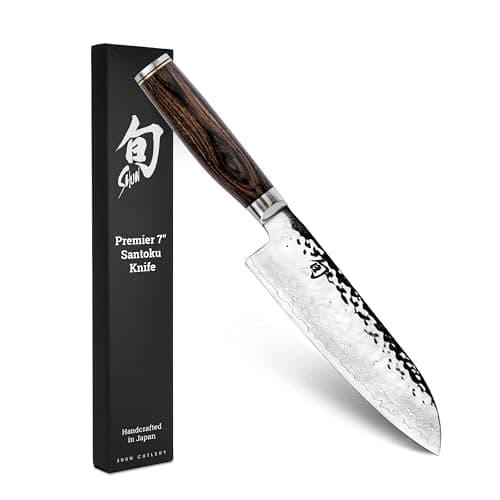
Shun
Shun Premier 7 in santoku, hammered finish
See price on Amazon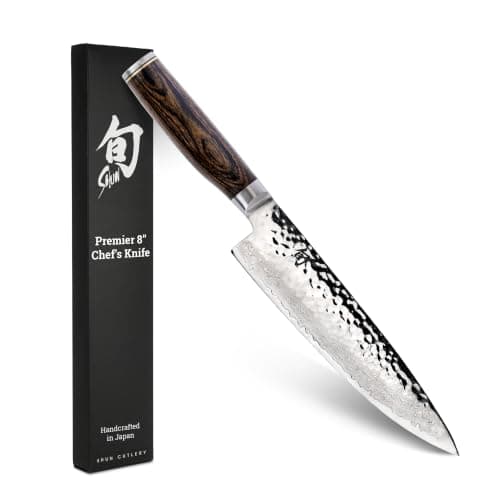
Shun
Shun Premier 8 in chef knife, VG-MAX, 16-degree edge
See price on Amazon
Wüsthof
Wusthof Classic Ikon 7" hollow-edge santoku, German
See price on Amazon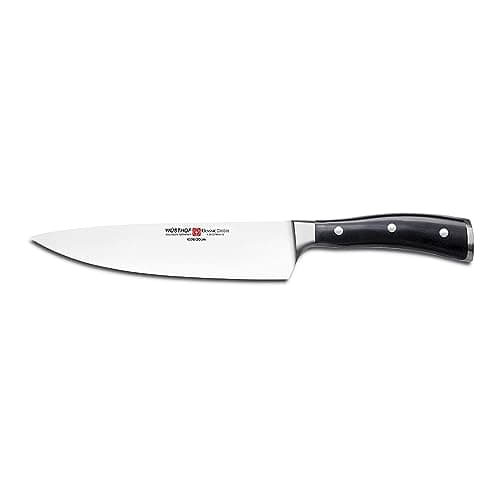
Wüsthof
Wusthof Classic Ikon 8" chef's knife, double bolster
See price on Amazon
- Shun Premier 7 in santoku, hammered finish
- Steel
- VG-MAX, 68-layer Damascus cladding
- Hardness (HRC)
- Not stated
- Blade length
- 7 in
- Edge angle
- 16 degrees
- Shun Premier 8 in chef knife, VG-MAX, 16-degree edge
- Steel
- VG-MAX core, 68-layer Damascus cladding
- Hardness (HRC)
- Not stated
- Blade length
- 8 in
- Edge angle
- 16 degrees
- Wusthof Classic Ikon 7" hollow-edge santoku, German
- Steel
- High carbon stainless steel
- Hardness (HRC)
- 58
- Blade length
- 7 in
- Edge angle
- 10 degrees
- Wusthof Classic Ikon 8" chef's knife, double bolster
- Steel
- High carbon stainless, forged
- Hardness (HRC)
- 58
- Blade length
- 8 in
- Edge angle
- Not stated
| Pick | Steel | Hardness (HRC) | Blade length | Edge angle | Price | Link |
|---|---|---|---|---|---|---|
| Shun Premier 7 in santoku, hammered finish | VG-MAX, 68-layer Damascus cladding | Not stated | 7 in | 16 degrees | - | Amazon |
| Shun Premier 8 in chef knife, VG-MAX, 16-degree edge | VG-MAX core, 68-layer Damascus cladding | Not stated | 8 in | 16 degrees | - | Amazon |
| Wusthof Classic Ikon 7" hollow-edge santoku, German | High carbon stainless steel | 58 | 7 in | 10 degrees | - | Amazon |
| Wusthof Classic Ikon 8" chef's knife, double bolster | High carbon stainless, forged | 58 | 8 in | Not stated | - | Amazon |
Facts are taken from each Amazon listing. Prices are checked daily and shown with their date.
Verdict
If you want one knife that handles the widest range of tasks and you like to rock-chop, buy an 8-inch chef knife such as the Shun Premier 8-inch or Wusthof Classic IKON 8-inch. If you have smaller hands, a small board or mostly push-cut vegetables, start with the matching 7-inch santoku from the same line.
This page is for cooks buying their first good knife or replacing a worn block set, who keep seeing the santoku and the chef knife side by side and cannot tell which one to start with. It explains how the two shapes differ in length, profile and tip, which cutting motions each one favors, and how that plays out with real tasks. To keep the comparison fair, it uses matched pairs from the same lines, the Shun Premier and the Wusthof Classic IKON, so the only real variable is shape.
How the two shapes differ
A Western chef knife and its Japanese cousin the gyuto share the same basic shape: a long blade, a gentle continuous curve from heel to tip and a sharp point. The curve lets you rock the blade, keeping the tip on the board while the heel rises and falls, and the length lets you draw long slices through roasts or melons in one stroke. Our gyuto explainer covers that shape in detail.
A santoku is shorter and taller in proportion, with a flatter edge that curves up only near the front, and the spine drops down to a rounded sheep's foot tip. The flat edge suits push cutting, where you drive the knife forward and down, and up-and-down chopping, where the whole edge meets the board at once. The rounded tip is less useful for fine point work but less likely to catch. See what a santoku is used for.
牛刀Gyuto
180 to 270 mm
三徳Santoku
165 to 180 mm
菜切Nakiri
160 to 180 mm
文化Bunka
165 to 180 mm
切付Kiritsuke
210 to 270 mm
筋引Sujihiki
240 to 300 mm
ペティPetty
120 to 150 mm
Matched pairs: spec table
These four knives come from two lines, so steel, handle and edge stay constant within each brand. Specs are taken only from the listings.
Blade length
- Shun Premier 7" Santoku
- 7 inch
- Shun Premier 8" Chef
- 8 inch
- Wusthof Classic IKON 7" Santoku
- 7 inch
- Wusthof Classic IKON 8" Chef
- 8 inch
Steel
- Shun Premier 7" Santoku
- VG-MAX, 68 layers Damascus cladding
- Shun Premier 8" Chef
- VG-MAX, 68 layers Damascus cladding
- Wusthof Classic IKON 7" Santoku
- High carbon stainless, 58 HRC
- Wusthof Classic IKON 8" Chef
- High carbon stainless, 58 HRC
Edge angle
- Shun Premier 7" Santoku
- 16 degrees
- Shun Premier 8" Chef
- 16 degrees
- Wusthof Classic IKON 7" Santoku
- 10 degree cutting edge
- Wusthof Classic IKON 8" Chef
- PEtec, angle not stated
Blade finish
- Shun Premier 7" Santoku
- Hammered tsuchime
- Shun Premier 8" Chef
- Hammered tsuchime
- Wusthof Classic IKON 7" Santoku
- Hollow edge
- Wusthof Classic IKON 8" Chef
- Plain, double bolster
Handle
- Shun Premier 7" Santoku
- Contoured Pakkawood
- Shun Premier 8" Chef
- Contoured Pakkawood
- Wusthof Classic IKON 7" Santoku
- Synthetic, double bolster
- Wusthof Classic IKON 8" Chef
- Synthetic, double bolster
Listed use
- Shun Premier 7" Santoku
- Vegetables, proteins and fruit
- Shun Premier 8" Chef
- Slicing, dicing, mincing
- Wusthof Classic IKON 7" Santoku
- Thinner than a chef knife, straighter edge
- Wusthof Classic IKON 8" Chef
- Chopping, mincing, slicing, dicing
| Spec | Shun Premier 7" Santoku | Shun Premier 8" Chef | Wusthof Classic IKON 7" Santoku | Wusthof Classic IKON 8" Chef |
|---|---|---|---|---|
| Blade length | 7 inch | 8 inch | 7 inch | 8 inch |
| Steel | VG-MAX, 68 layers Damascus cladding | VG-MAX, 68 layers Damascus cladding | High carbon stainless, 58 HRC | High carbon stainless, 58 HRC |
| Edge angle | 16 degrees | 16 degrees | 10 degree cutting edge | PEtec, angle not stated |
| Blade finish | Hammered tsuchime | Hammered tsuchime | Hollow edge | Plain, double bolster |
| Handle | Contoured Pakkawood | Contoured Pakkawood | Synthetic, double bolster | Synthetic, double bolster |
| Listed use | Vegetables, proteins and fruit | Slicing, dicing, mincing | Thinner than a chef knife, straighter edge | Chopping, mincing, slicing, dicing |
Rocking vs push cutting
The cutting motion you already use matters more than any spec. Many US home cooks learned to rock a chef knife, especially for mincing herbs and garlic. The curved belly of an 8-inch chef knife makes that easy. A santoku has little belly, so rocking feels choppy and the edge slaps the board.
Cooks who push cut or chop straight down often find the santoku more natural. The flat edge contacts the board along its length, so a stack of scallions or a pile of sliced carrots separates cleanly with fewer incomplete cuts. The Wusthof IKON santoku listing notes it is thinner than the traditional chef knife with a straighter edge, which is exactly the trait that suits this style. Our guide on how to cut with a chef knife shows both motions.
- Mostly rock-chop and mince: chef knife.
- Mostly push cut and chop vegetables: santoku.
- Slice large roasts, melons, cabbage: chef knife for the extra inch.
- Small board or cramped counter: santoku.
Length, tip work and the one-knife kitchen
The extra inch of an 8-inch chef knife matters most on big items: halving a large squash, slicing a brisket or cutting a whole cabbage. It also gives more room to rock without the heel hitting your knuckles. The pointed tip handles fine work such as scoring, trimming silver skin or opening a pepper, which reduces the need for a separate paring knife.
A 7-inch santoku is easier to control for many people, especially those with smaller hands, and it fits on smaller boards. The tall blade gives good knuckle clearance and works as a scoop to move food into a pan. What it gives up is reach and the fine point. If you are building around one knife, our chef knife size guide and how many knives you need pages help you plan the rest.
Japanese vs German versions of each shape
Both shapes come in Japanese and German styles, and that choice changes the feel as much as the shape does. The Shun Premier pair uses VG-MAX steel and a 16-degree edge for a thin, light, very sharp blade that needs gentle care. The Wusthof Classic IKON pair uses 58 HRC stainless with a double bolster, so it is heavier and more forgiving of rough use.
Interestingly, Wusthof gives its IKON santoku a 10 degree edge, sharper than the chef knife in the same line, because the santoku is meant for finer vegetable work. If you want a deeper look at brand differences, see Shun vs Wusthof. If you lean Japanese and want the classic long blade, our gyuto guide lists 210 and 240 mm options.
Frequently asked questions
Is a santoku better than a chef knife for vegetables? For push cutting and chopping vegetables a santoku often feels faster and cleaner thanks to its flat edge. A chef knife still handles vegetables well, and it is better for rock-mincing herbs and slicing large produce.
Can a santoku replace a chef knife? For many home cooks, yes. It covers everyday slicing, dicing and mincing. You give up some length for big items and the pointed tip for fine work, so you may want a petty knife alongside it.
What size santoku and chef knife should I buy? Santokus are most commonly 7 inches, about 180 mm. For chef knives, 8 inches or about 210 mm is the usual home size, with 240 mm for cooks who like more reach.
What about a gyuto vs santoku? A gyuto is the Japanese chef knife, so the same logic applies. See our dedicated gyuto vs santoku comparison for Japanese-only picks.
What you need for this
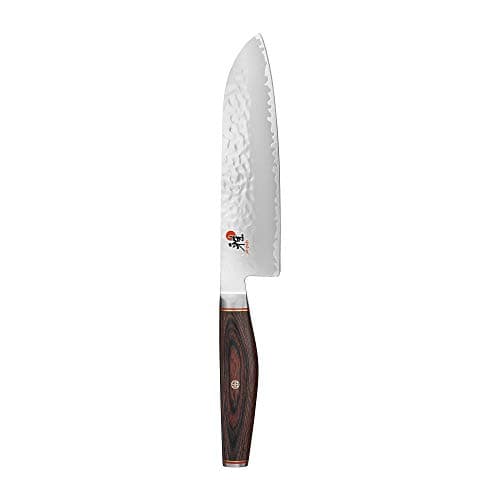 See price on AmazonAmazon
Miyabi Artisan 7" santoku in SG2 at 63 HRC
 See price on AmazonAmazon
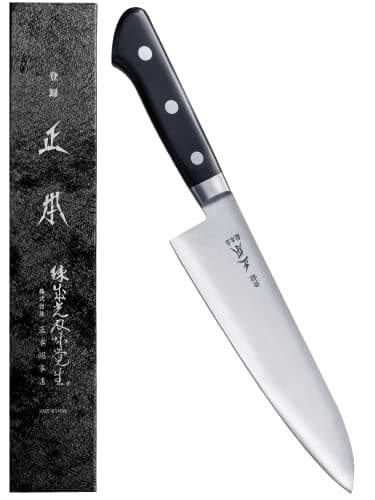
Masamoto VG 240 mm gyuto, HRC 58-59, POM handle
From Best gyuto knives: Japanese chef knives in 210 and 240 mm
 See price on AmazonAmazon
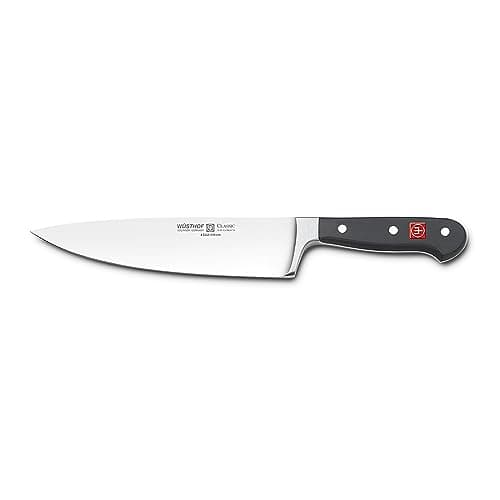
Wusthof Classic 8" chef's knife, forged at 58 HRC
From Best premium German chef knives to compare with a gyuto
 See price on AmazonAmazon
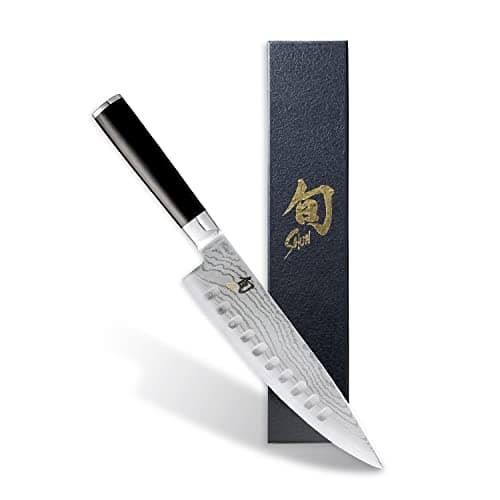
Shun Classic 8 in hollow ground chef, 16-degree
From Best Japanese knives for beginners: forgiving first picks