Explainer
What size chef knife do I need: 180, 210, 240 or 270 mm
Published
Short answer
Most home cooks do best with a 210 mm (about 8.25 inch) gyuto or an 8 inch Western chef knife. Choose 180 mm if you have a small board or small hands, and 240 mm if you have a large board, cook big batches and are comfortable with a longer blade. A 270 mm knife is mainly for professional kitchens.
Picks for this job
All 8 picks compared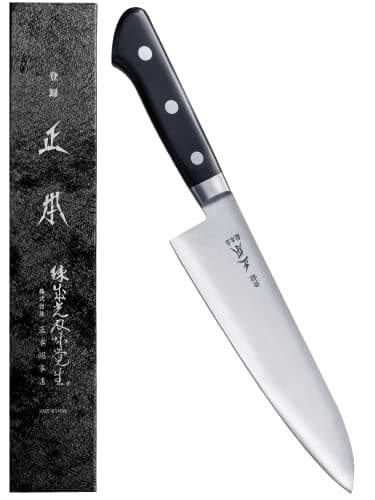
Masamoto VG 240 mm gyuto, HRC 58-59, POM handle
See price on AmazonSee it on Amazon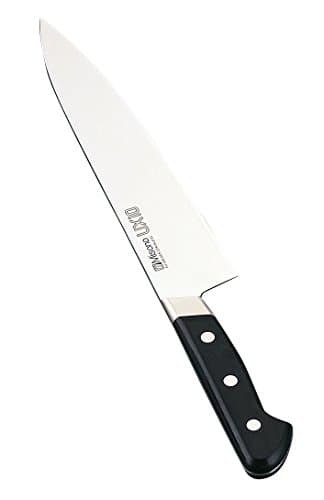
Misono UX10 210 mm gyuto in Swedish stainless
See price on AmazonSee it on Amazon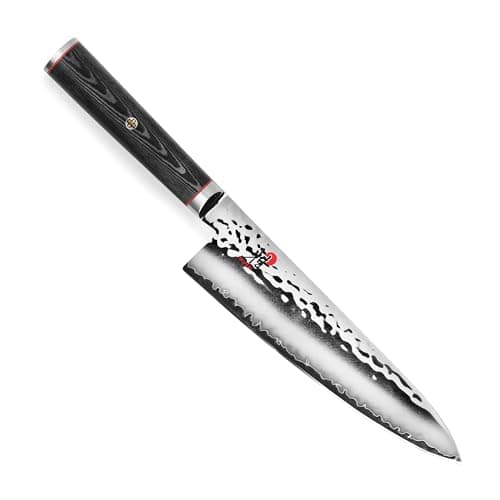
Miyabi Mizu SG2 8 in chef knife at 63 HRC
See price on AmazonSee it on Amazon
Japanese chef knives (gyuto) are sold in millimeters, while Western knives are sold in inches, which makes shopping confusing. This page gives a simple length table, explains how your cutting board, hand size and cooking habits should guide the choice, and covers the trade-offs of going shorter or longer. It is for home cooks buying a first Japanese chef knife or upgrading from a German 8 inch knife.
Chef knife sizes in mm and inches
Blade length is measured from the tip to the heel of the edge, not including the handle. Japanese makers round to the nearest common size, so a 210 mm gyuto may measure a few millimeters more or less. The table converts the standard sizes and shows who each length suits.
- Tip
- The point, for fine work
- Belly
- The curve of the edge, for rocking cuts
- Flat
- The straight part of the edge near the heel
- Heel
- The rear corner of the edge
- Choil
- Where the edge ends at the handle
- Spine
- The thick back of the blade
- Ferrule
- The collar of a wa handle; a Western knife has a bolster
- Tang
- The steel inside the handle
- HRC
- Hardness of the steel, here 60-61
150-165 mm
- Inches (approx.)
- 6-6.5 in
- Board size it suits
- Small boards, under 14 in wide
- Best for
- Small kitchens, petty or utility backup
180 mm
- Inches (approx.)
- 7 in
- Board size it suits
- 14-16 in wide
- Best for
- Small hands, light prep, tight counters
210 mm
- Inches (approx.)
- 8.25 in
- Board size it suits
- 16-18 in wide
- Best for
- Most home cooks, all-round prep
240 mm
- Inches (approx.)
- 9.5 in
- Board size it suits
- 18 in or wider
- Best for
- Big batches, large produce, long slices
270 mm
- Inches (approx.)
- 10.5 in
- Board size it suits
- 20 in or wider
- Best for
- Professional kitchens, very large prep
| Length | Inches (approx.) | Board size it suits | Best for |
|---|---|---|---|
| 150-165 mm | 6-6.5 in | Small boards, under 14 in wide | Small kitchens, petty or utility backup |
| 180 mm | 7 in | 14-16 in wide | Small hands, light prep, tight counters |
| 210 mm | 8.25 in | 16-18 in wide | Most home cooks, all-round prep |
| 240 mm | 9.5 in | 18 in or wider | Big batches, large produce, long slices |
| 270 mm | 10.5 in | 20 in or wider | Professional kitchens, very large prep |
Why 210 mm is the usual starting point
A 210 mm gyuto is close to the 8 inch chef knife that most US cooks already know. It is long enough to slice through a large onion or a cabbage half in one stroke, and short enough to control on a normal home board. Most major lines, including Shun, Miyabi, Global and MAC, offer a 210 mm or 8 inch chef knife, so you have the most choice at this length.
Japanese knives are usually thinner and lighter than German knives of the same length. That means a 210 mm gyuto often feels more nimble than an 8 inch Wusthof or Zwilling, and some cooks who found an 8 inch German knife heavy are comfortable going longer with a Japanese one. Our Japanese vs German knives page explains the differences.
When to choose 240 mm
Many professional cooks prefer 240 mm. The extra length lets you slice in longer strokes, which means fewer passes and cleaner cuts through big items like watermelon, large roasts and stacks of herbs. Because more of the edge is in use, it also stays sharp feeling for longer between touch-ups.
The trade-offs are space and control. A 240 mm blade needs a board at least 18 inches wide, and on a narrow counter the tip can hang over the edge. If you are new to Japanese knives, start with 210 mm and add a longer knife later if you want one. Browse lengths in our best gyuto knives guide.
When a shorter knife makes sense
A 180 mm gyuto or a santoku is a good fit if you have small hands, cook in a small space, or mostly cut vegetables and boneless protein for one or two people. Shorter knives are easier to control and to store. They are less efficient for large items, because you need more strokes.
Some cooks with smaller hands still prefer 210 mm because of the reach. Hand size is a guide, not a rule. What matters most is whether you feel in control with a pinch grip. See how to hold a chef knife.
How to choose: a quick checklist
- 1
Measure your cutting board. Your knife should be clearly shorter than the board is wide, ideally by 2 inches or more on each side of your stroke.
- 2
Think about what you cut most. Mostly vegetables and small proteins: 180-210 mm. Big roasts, melons and large batches: 240 mm.
- 3
Consider your current knife. If an 8 inch chef knife feels right, a 210 mm gyuto will feel familiar.
- 4
Check blade height. A taller blade at the same length gives more knuckle clearance and feels larger in use.
- 5
Plan the rest of your set. A chef knife plus a 120-150 mm petty knife covers most kitchens. See how many knives do you need.
Note.Length is not the only factor. Weight, balance, blade height and handle style change how a knife feels, so a 240 mm Japanese knife can feel lighter than a 210 mm German one.
Other shapes and their usual sizes
If you are building a set, these are the common lengths for other Japanese shapes. A santoku and a bunka are usually 165-180 mm. A nakiri is usually 165-180 mm. A sujihiki slicer runs 240-300 mm. A petty knife is 120-150 mm. Our types of Japanese knives page explains each one, and best Japanese kitchen knives lists picks in each size.
Frequently asked questions
What is the standard chef knife length? In the US the standard is 8 inches, which matches a 210 mm gyuto closely. Japanese professional cooks often use 240 mm.
Is a 240 mm gyuto too big for a home cook? Not if you have a large board and like long strokes. On a small board or narrow counter it can be awkward, and 210 mm is easier.
Is a 10 inch chef knife too long? For most home kitchens, yes. A 10 inch (about 250-270 mm) knife needs a big board and suits large batch prep.
Should a beginner start with 180 or 210 mm? Most beginners do well with 210 mm. Choose 180 mm if your board is small or a longer blade feels hard to control.
What you need for this
- See price on AmazonAmazon
Masamoto VG 240 mm gyuto, HRC 58-59, POM handle
From Best gyuto knives: Japanese chef knives in 210 and 240 mm
 See price on AmazonAmazon
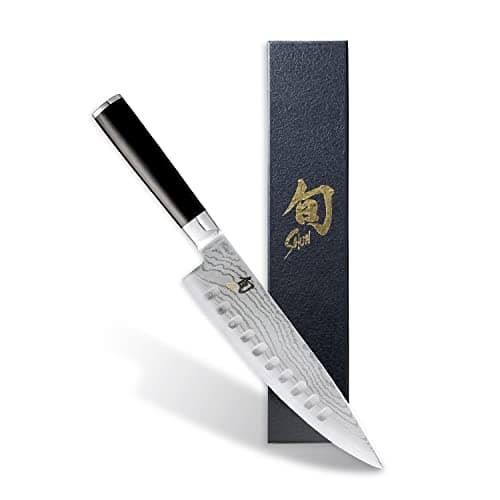
Shun Classic 8 in hollow ground chef, 16-degree
From Best Japanese knives for beginners: forgiving first picks
 See price on AmazonAmazon
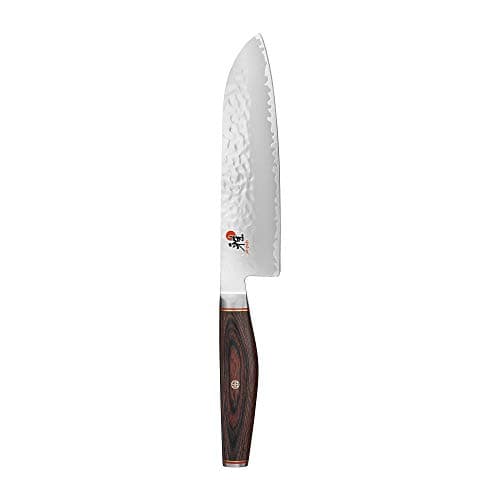
Miyabi Artisan 7" santoku in SG2 at 63 HRC