Comparison
Japanese vs German knives: hardness, angle and feel
Published
Short answer
Japanese knives are usually harder (about HRC 60 to 63), thinner and sharpened to a lower angle, so they cut with less effort and stay sharp longer but can chip if twisted or used on bone. German knives are softer (about HRC 56 to 58), thicker and heavier, with wider edges that dull sooner but shrug off rough use and are easy to touch up with a honing steel.
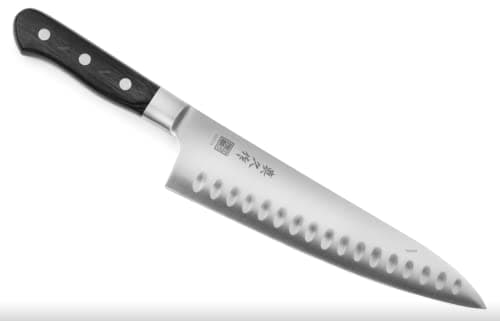
MAC MIGHTY
MAC MTH-80 Professional 8" dimpled chef's knife
See price on Amazon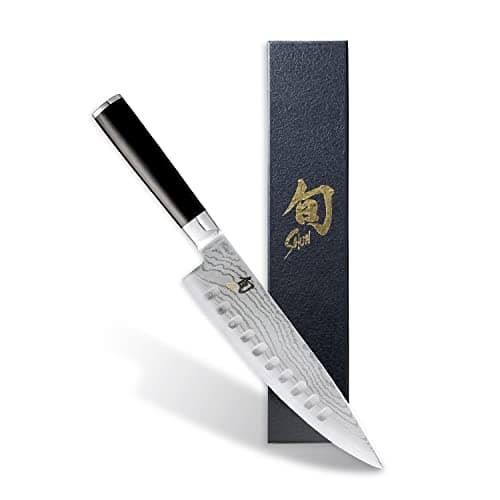
Shun
Shun Classic 8 in hollow ground chef, 16-degree
See price on Amazon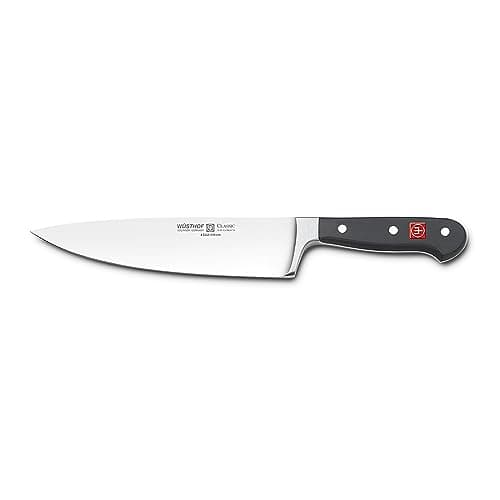
Wüsthof
Wusthof Classic 8" chef's knife, forged at 58 HRC
See price on Amazon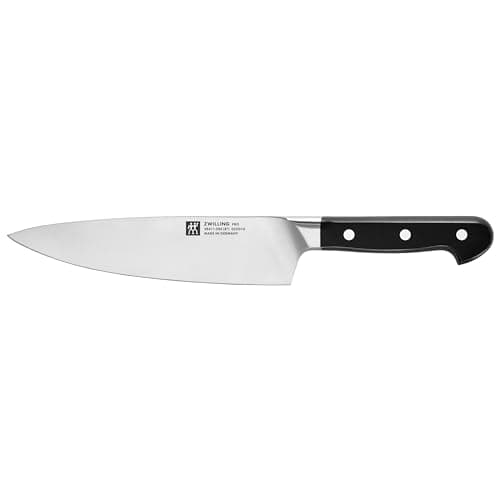
ZWILLING
Zwilling Pro 8" chef's knife with curved bolster
See price on Amazon
- MAC MTH-80 Professional 8" dimpled chef's knife
- Steel
- Molybdenum vanadium stainless
- Handle
- Not stated
- Hardness (HRC)
- -
- Blade length
- -
- Shun Classic 8 in hollow ground chef, 16-degree
- Steel
- VG-MAX, 68-layer Damascus cladding
- Handle
- D-shaped Pakkawood
- Hardness (HRC)
- Not stated
- Blade length
- 8 in
- Wusthof Classic 8" chef's knife, forged at 58 HRC
- Steel
- High carbon stainless, forged
- Handle
- Synthetic, triple riveted, full tang
- Hardness (HRC)
- 58
- Blade length
- 8 in
- Zwilling Pro 8" chef's knife with curved bolster
- Steel
- Special formula high-carbon stainless, ice-hardened
- Handle
- Triple riveted, full tang
- Hardness (HRC)
- Not stated
- Blade length
- 8 in
| Pick | Steel | Handle | Hardness (HRC) | Blade length | Price | Link |
|---|---|---|---|---|---|---|
| MAC MTH-80 Professional 8" dimpled chef's knife | Molybdenum vanadium stainless | Not stated | - | - | - | Amazon |
| Shun Classic 8 in hollow ground chef, 16-degree | VG-MAX, 68-layer Damascus cladding | D-shaped Pakkawood | Not stated | 8 in | - | Amazon |
| Wusthof Classic 8" chef's knife, forged at 58 HRC | High carbon stainless, forged | Synthetic, triple riveted, full tang | 58 | 8 in | - | Amazon |
| Zwilling Pro 8" chef's knife with curved bolster | Special formula high-carbon stainless, ice-hardened | Triple riveted, full tang | Not stated | 8 in | - | Amazon |
Facts are taken from each Amazon listing. Prices are checked daily and shown with their date.
Verdict
Choose a Japanese knife such as the MAC MTH-80 or Shun Classic if you want a light, very sharp blade for precise prep and will hand wash and sharpen on stones. Choose a German knife such as the Wusthof Classic or Zwilling Pro if you want a tougher, heavier blade that tolerates rough use and easy honing.
This page is for cooks choosing between a Japanese gyuto and a German chef's knife, or wondering why a Japanese knife feels so different from the Wusthof or Zwilling they grew up with. It compares hardness, edge angle, blade thickness, weight, handle style and upkeep, using real listings such as the MAC MTH-80, Shun Classic, Wusthof Classic and Zwilling Pro as examples. It ends with a clear recommendation for different kinds of cooks.
The core difference: hard and thin vs tough and thick
Most of what separates the two styles comes from one choice. Japanese makers heat treat steel harder so it can hold a thinner, more acute edge. German makers keep steel a little softer so the blade can flex and take abuse without chipping. Everything else follows: Japanese knives are lighter and slice with less force, while German knives are heavier and better at powering through squash or a chicken joint.
Hardness is measured on the Rockwell C scale. The Wusthof Classic listing gives 58 HRC; Global, a Japanese brand that sits closer to German hardness, lists HRC 56 to 58 for its SAI line. Shun's VG-MAX and Miyabi's FC61 sit near HRC 61, and SG2 knives such as the Miyabi Mizu are listed at HRC 63. Read what HRC means for the background.
- Edge retention
- rises with hardness
- Chip risk
- rises with hardness
- Ease of sharpening
- falls with hardness
Steels on the chart: X50CrMoV15 HRC 56 to 58; Cromova 18 HRC 56 to 58; AUS-10 HRC 59 to 60; VG-10 HRC 60 to 61; VG-MAX HRC 60 to 61; FC61 HRC 61 to 61; Ginsan (Silver 3) HRC 60 to 61; SG2 / R2 HRC 62 to 64; ZDP-189 HRC 64 to 66; Shirogami 1 and 2 HRC 61 to 64; Aogami 1 and 2 HRC 61 to 64; Aogami Super HRC 63 to 65.
Side by side comparison
The table mixes listing facts for specific knives with the typical published edge angles for each brand. Edge angles are per side, so a 15 degree knife has a 30 degree included angle.
MAC MTH-80 Professional
- Origin
- Japan
- Steel
- Molybdenum vanadium stainless
- Hardness
- Not listed
- Edge per side
- Not listed
- Handle
- Western, dimpled 200 mm blade
Shun Classic 8"
- Origin
- Japan
- Steel
- VG-MAX, Damascus clad
- Hardness
- Not listed
- Edge per side
- 16 degrees
- Handle
- D-shaped Pakkawood
Wusthof Classic 8"
- Origin
- Germany
- Steel
- High carbon stainless
- Hardness
- HRC 58
- Edge per side
- 14 degrees (PEtec, brand spec)
- Handle
- Triple riveted synthetic, full bolster
Zwilling Pro 8"
- Origin
- Germany
- Steel
- Special formula high carbon stainless, FRIODUR
- Hardness
- Not listed
- Edge per side
- 15 degrees (brand spec)
- Handle
- Triple riveted, curved bolster
| Knife | Origin | Steel | Hardness | Edge per side | Handle |
|---|---|---|---|---|---|
| MAC MTH-80 Professional | Japan | Molybdenum vanadium stainless | Not listed | Not listed | Western, dimpled 200 mm blade |
| Shun Classic 8" | Japan | VG-MAX, Damascus clad | Not listed | 16 degrees | D-shaped Pakkawood |
| Wusthof Classic 8" | Germany | High carbon stainless | HRC 58 | 14 degrees (PEtec, brand spec) | Triple riveted synthetic, full bolster |
| Zwilling Pro 8" | Germany | Special formula high carbon stainless, FRIODUR | Not listed | 15 degrees (brand spec) | Triple riveted, curved bolster |
How they cut
A thin, hard Japanese blade like a gyuto falls through onions, tomatoes and herbs with very little downward pressure. Food crushes less, so herbs bruise less and tomato skins do not need a sawing motion. Most gyutos also have a flatter profile toward the heel, which favors push cuts and slicing over rocking. Our gyuto vs santoku page covers the shapes.
A German chef's knife has more curve along the edge and a thicker spine. It rocks well for mincing herbs and garlic, and its weight helps through dense vegetables. The full bolster on knives like the Wusthof Classic protects fingers but makes the heel harder to sharpen over time. If you like a rocking motion and a heavy knife, German is a natural fit; if you like gliding cuts and a light knife, Japanese is.
Durability and upkeep
The harder Japanese edge stays sharp longer, but it is more brittle. It can chip if you hit bone, pry at frozen food, scrape the board sideways or drop it in a sink. German steel will roll rather than chip, and a few strokes on a honing steel push it back into line. That is why German knives forgive rough habits better.
Sharpening also differs. Japanese knives are best sharpened on whetstones at their original angle. Many electric and pull-through sharpeners are set to 20 degrees, which suits older German knives but thickens a Japanese edge. A ceramic or fine honing rod works on both, but use light pressure on the hard Japanese steel. See honing rods for Japanese knives and the whetstone guide.
- Both: hand wash and dry, no dishwasher.
- Japanese: avoid bones, frozen food and glass or stone boards; sharpen on whetstones.
- German: hone often, sharpen less often; safe for heavier jobs like splitting squash.
- Carbon steel Japanese knives also need wiping dry right away to avoid rust.
Note.Use our sharpening angle finder before sharpening: Japanese knives commonly need 10 to 16 degrees per side, German knives 14 to 15.
Weight, balance and handles
The Wusthof Classic 8" listing gives a weight of 8.5 ounces with a full bolster and a 4.5 inch handle. Japanese gyutos of the same length are commonly lighter because the blade is thinner and many skip the heavy bolster. Lighter knives tire the hand less during long prep but give less momentum for chopping.
Handles split into Western style (riveted or molded, like MAC, Wusthof and Zwilling) and Japanese wa handles (octagonal or D-shaped, like Shun Classic). Many Japanese knives sold in the US, including the MAC MTH-80, use a Western handle, so you can get a Japanese blade without changing your grip. See wa vs Western handles.
Octagonal wa
Light, eight flat faces, works in either hand.
D-shaped wa
Light, with a ridge for the fingers. Made for one hand.
Western yo
Full tang between two scales and three rivets. Heavier at the back.
Which should you buy
Pick Japanese if you mostly cut vegetables, fish and boneless meat, you are willing to hand wash and use a decent board, and you want the knife to stay sharp for longer between sharpenings. A MAC MTH-80 or Shun Classic is a sensible first step; see our best Japanese knives for beginners.
Pick German if the knife will be shared by a busy household, you break down chickens or squash often, or you prefer honing over whetstone sharpening. The Wusthof Classic and Zwilling Pro are the reference points; our best German chef knives guide compares them. Many cooks end up with both: a Japanese gyuto for precision and a German knife for heavy jobs.
Frequently asked questions
Is a gyuto the same as a Western chef's knife? A gyuto is the Japanese version of the chef's knife. It is usually thinner, harder and flatter near the heel than a German chef's knife of the same length.
Are Japanese knives sharper than German knives? Out of the box they are usually sharper because of the lower edge angle, and they stay sharp longer because of the harder steel. A well-sharpened German knife is still very sharp.
Why do Japanese knives chip? High hardness makes the edge less tough. Twisting, hitting bone or cutting on glass and stone can break off small pieces. Small chips can be sharpened out; see chipped Japanese knife.
Can I use a honing steel on a Japanese knife? Use a smooth or fine ceramic rod with light strokes. Coarse grooved steels can damage hard edges.
What you need for this
- See price on AmazonAmazon
Wusthof Classic 8" chef's knife, forged at 58 HRC
From Best premium German chef knives to compare with a gyuto
 See price on AmazonAmazon
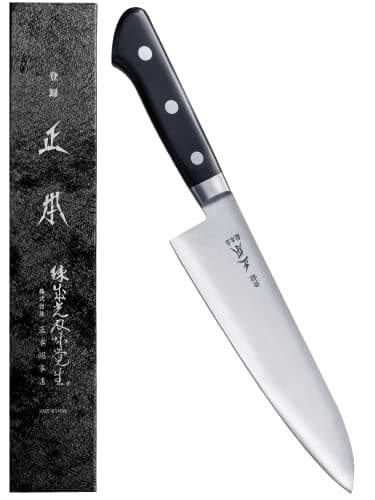
Masamoto VG 240 mm gyuto, HRC 58-59, POM handle
From Best gyuto knives: Japanese chef knives in 210 and 240 mm
- See price on AmazonAmazon
Shun Classic 8 in hollow ground chef, 16-degree
From Best Japanese knives for beginners: forgiving first picks
 See price on AmazonAmazon
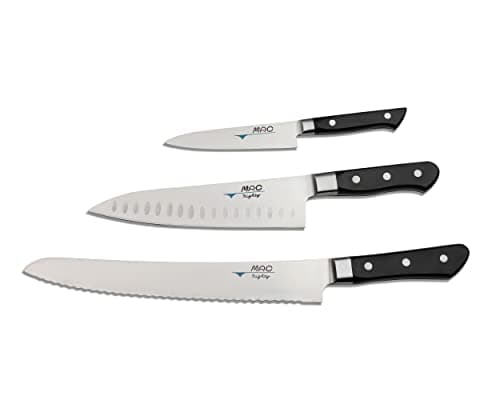
MAC PRO-31 Professional 3-piece set with MTH-80