Comparison
Gyuto vs santoku: length, tip and cutting style
Published
Short answer
A gyuto is the Japanese chef's knife: usually 210 to 240 mm long with a pointed tip and a gentle curve, so it handles slicing, rocking, push cuts and meat. A santoku is shorter, usually 165 to 180 mm, with a flatter edge and a rounded sheepsfoot tip that favors chopping vegetables with an up and down motion. Pick a gyuto for range and bigger boards, a santoku for compact kitchens and mostly vegetables.
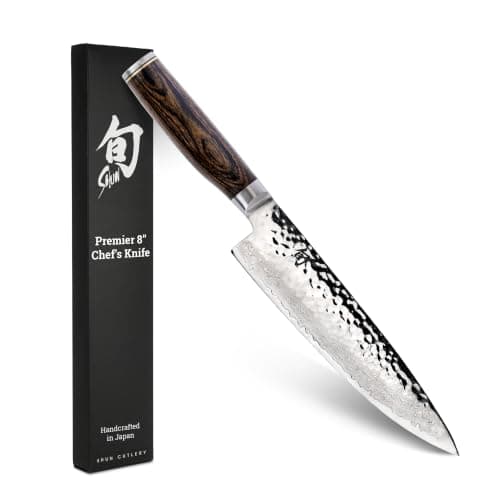
Shun
Shun Premier 8 in chef knife, VG-MAX, 16-degree edge
See price on Amazon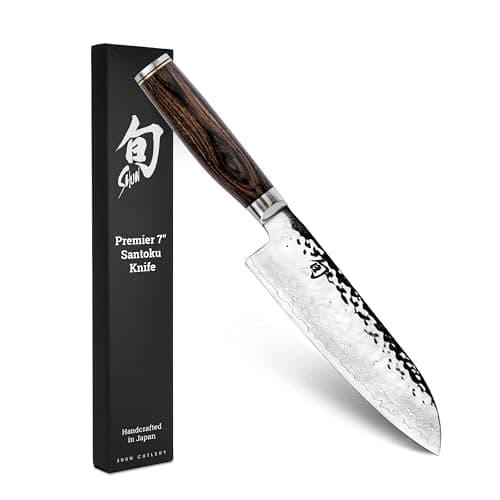
Shun
Shun Premier 7 in santoku, hammered finish
See price on Amazon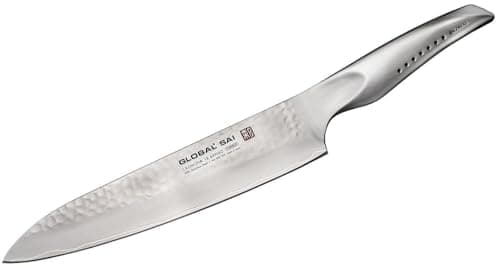
Global
Global SAI-02 8 in chef knife, HRC 56-58
See price on Amazon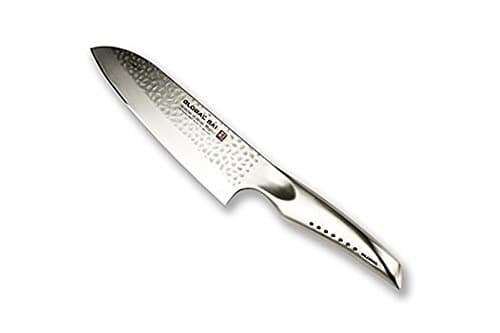
Global
Global SAI-03 7.5" santoku, Cromova 18 steel
See price on Amazon
- Shun Premier 8 in chef knife, VG-MAX, 16-degree edge
- Steel
- VG-MAX core, 68-layer Damascus cladding
- Hardness (HRC)
- Not stated
- Blade length
- 8 in
- Edge angle
- 16 degrees
- Shun Premier 7 in santoku, hammered finish
- Steel
- VG-MAX, 68-layer Damascus cladding
- Hardness (HRC)
- Not stated
- Blade length
- 7 in
- Edge angle
- 16 degrees
- Global SAI-02 8 in chef knife, HRC 56-58
- Steel
- Cordova 18 stainless (as listed)
- Hardness (HRC)
- 56-58
- Blade length
- 8 in
- Edge angle
- Not stated
- Global SAI-03 7.5" santoku, Cromova 18 steel
- Steel
- Cromova 18 stainless
- Hardness (HRC)
- 56-58
- Blade length
- 7.5 in
- Edge angle
- Not stated
| Pick | Steel | Hardness (HRC) | Blade length | Edge angle | Price | Link |
|---|---|---|---|---|---|---|
| Shun Premier 8 in chef knife, VG-MAX, 16-degree edge | VG-MAX core, 68-layer Damascus cladding | Not stated | 8 in | 16 degrees | - | Amazon |
| Shun Premier 7 in santoku, hammered finish | VG-MAX, 68-layer Damascus cladding | Not stated | 7 in | 16 degrees | - | Amazon |
| Global SAI-02 8 in chef knife, HRC 56-58 | Cordova 18 stainless (as listed) | 56-58 | 8 in | Not stated | - | Amazon |
| Global SAI-03 7.5" santoku, Cromova 18 steel | Cromova 18 stainless | 56-58 | 7.5 in | Not stated | - | Amazon |
Facts are taken from each Amazon listing. Prices are checked daily and shown with their date.
Verdict
Get a gyuto such as the Shun Premier 8" or Global SAI-02 if you want the most versatile single knife and have the board space. Get a santoku such as the Shun Premier 7" or Global SAI-03 if you mostly chop vegetables, work in a small kitchen or prefer a shorter, sturdier tip.
This page is for cooks choosing one main Japanese knife who are stuck between a gyuto and a santoku. Both are all-purpose knives and both are double beveled, so either can be your only knife. The differences are length, tip shape, edge profile and how they suit your board and cutting motion. We compare them in matched pairs from the same series, the Shun Premier and Global SAI chef's knives and santokus, so the shape is the only thing changing.
Shape differences in plain terms
A gyuto looks like a slimmer Western chef's knife. It has a pointed tip, a belly that curves up toward the tip, and a fairly straight section near the heel. The name means cow sword, a reference to its original use on beef. Read more in what is a gyuto knife used for.
A santoku is shorter and taller at the heel relative to its length, with a flat edge and a tip that curves down from the spine to meet it. The name is usually translated as three virtues, meaning meat, fish and vegetables, or slicing, dicing and mincing. See what is a santoku knife used for.
牛刀Gyuto
180 to 270 mm
三徳Santoku
165 to 180 mm
菜切Nakiri
160 to 180 mm
文化Bunka
165 to 180 mm
切付Kiritsuke
210 to 270 mm
筋引Sujihiki
240 to 300 mm
ペティPetty
120 to 150 mm
Matched pairs from the listings
These pairs share steel, edge and handle within each brand, so they isolate the shape. Lengths and specs come from the listings.
Shun Premier 8" Chef's
- Shape
- Gyuto style
- Blade length
- 8 in
- Steel and hardness
- VG-MAX, 68-layer Damascus
- Edge per side
- 16 degrees
Shun Premier 7" Santoku
- Shape
- Santoku
- Blade length
- 7 in
- Steel and hardness
- VG-MAX, 68-layer Damascus
- Edge per side
- 16 degrees
Global SAI-02 Chef's
- Shape
- Gyuto style
- Blade length
- 8 in
- Steel and hardness
- Cromova 18, HRC 56-58
- Edge per side
- Not listed
Global SAI-03 Santoku
- Shape
- Santoku
- Blade length
- 7.5 in
- Steel and hardness
- Cromova 18, HRC 56-58
- Edge per side
- Not listed
| Knife | Shape | Blade length | Steel and hardness | Edge per side |
|---|---|---|---|---|
| Shun Premier 8" Chef's | Gyuto style | 8 in | VG-MAX, 68-layer Damascus | 16 degrees |
| Shun Premier 7" Santoku | Santoku | 7 in | VG-MAX, 68-layer Damascus | 16 degrees |
| Global SAI-02 Chef's | Gyuto style | 8 in | Cromova 18, HRC 56-58 | Not listed |
| Global SAI-03 Santoku | Santoku | 7.5 in | Cromova 18, HRC 56-58 | Not listed |
Length and board size
Length is the biggest practical difference. A longer gyuto slices a roast or a large cabbage in one stroke and keeps your knuckles clear of the board on wide items. It also needs room: a 240 mm gyuto on a small board means the tip hangs off or hits the backsplash. A 210 mm gyuto, about 8.25 inches, suits most home boards.
A santoku in the 165 to 180 mm range is easier to handle in a tight kitchen, on a small board, or for cooks with smaller hands. Our what size chef knife do I need page has a quick rule: use a board at least as wide as the blade is long plus a few inches.
Cutting motion and tip
Match the knife to how you already cut. If you rock the knife on its belly to mince herbs and garlic, the gyuto's curve suits you. If you lift the whole knife and chop straight down or push forward, the santoku's flatter edge keeps full contact with the board, which makes cleaner cuts through vegetables.
The tip matters too. A gyuto's sharp point is useful for scoring, trimming silver skin, and fine work around bones in meat. A santoku's dropped tip is stronger and less likely to snap, but it cannot do detail work. Many santoku owners add a petty knife for that.
- Rock chopping and mincing: gyuto.
- Push cuts and straight chopping of vegetables: santoku or gyuto, santoku slightly easier.
- Slicing boneless meat and fish: gyuto.
- Small board or cramped counter: santoku.
- Tip work like scoring and trimming: gyuto.
What about kiritsuke, nakiri and bunka?
If you like the gyuto's length but prefer a flat edge, look at a kiritsuke, which adds an angled tip. Our gyuto vs kiritsuke page compares them. If you like the santoku's height but mainly cut vegetables, a nakiri is flatter still. A bunka is a santoku-sized knife with a pointed reverse tanto tip, a middle ground between the two.
For a full map of shapes, see types of Japanese knives.
Which should you buy
Choose a gyuto if you want one knife that does everything including meat and large items, you have a board around 18 inches wide or larger, and you are comfortable with an 8 inch knife. Our best gyuto knives guide covers 210 and 240 mm picks.
Choose a santoku if you mostly prep vegetables, work in a smaller space, or find 8 inch knives unwieldy. Both shapes come in the same steels, so you do not give up quality either way.
Frequently asked questions
Is a santoku or gyuto better for beginners? Either works. A santoku is less intimidating and its tip is sturdier; a gyuto teaches a more versatile technique. Choose by board size and cutting style.
Can a santoku replace a chef's knife? For most home cooking, yes. It struggles with large roasts, whole melons and tasks that need a pointed tip.
What length gyuto should I get? 210 mm is the common home choice. 240 mm suits cooks with large boards and more experience.
Why do some santokus have dimples? Hollow ground dimples, like on the Global Ukon santoku, reduce sticking. They help a little with starchy vegetables like potatoes.
What you need for this
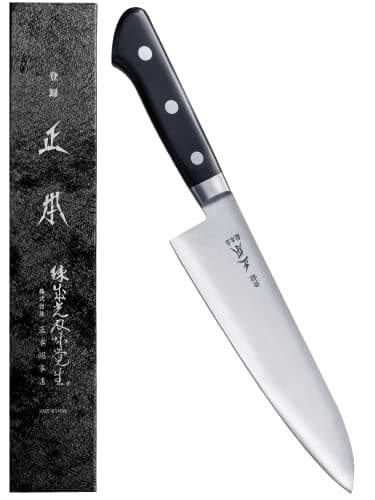 See price on AmazonAmazon
Masamoto VG 240 mm gyuto, HRC 58-59, POM handle
From Best gyuto knives: Japanese chef knives in 210 and 240 mm
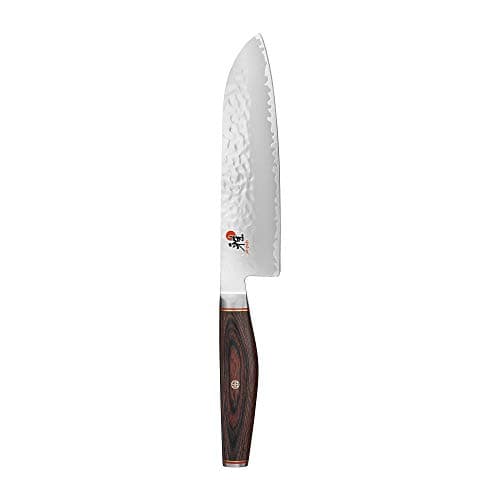 See price on AmazonAmazon
Miyabi Artisan 7" santoku in SG2 at 63 HRC
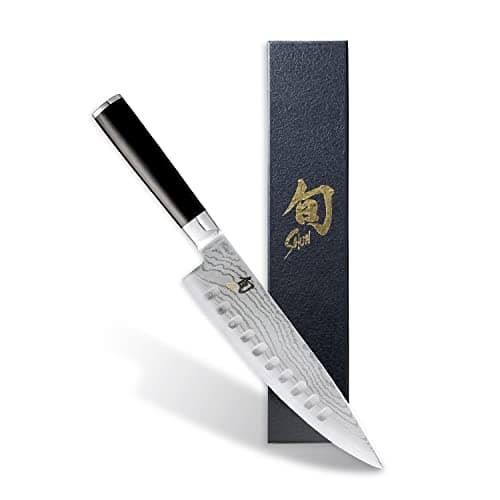 See price on AmazonAmazon
Shun Classic 8 in hollow ground chef, 16-degree
From Best Japanese knives for beginners: forgiving first picks