Comparison
Gyuto vs kiritsuke: does the angled tip matter
Published
Short answer
A gyuto has a curved belly and a centered point, so it rocks, slices and push cuts. A double-bevel kiritsuke has a flatter edge and an angled, clipped tip, so it excels at push cuts and long slices but rocks poorly. The angled tip is useful for fine scoring, though it is thinner and more fragile. For most home cooks the gyuto is the safer all-rounder; pick a kiritsuke if you push cut and like the look.
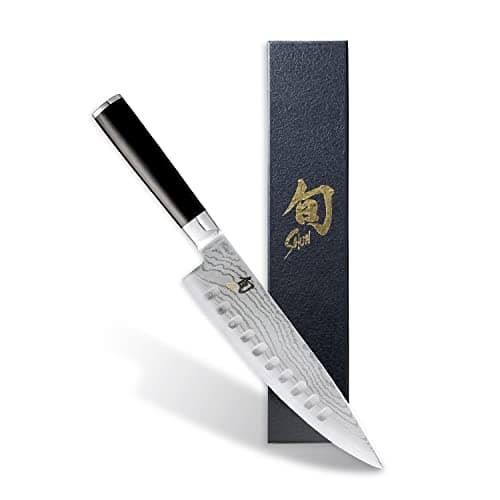
Shun
Shun Classic 8 in hollow ground chef, 16-degree
See price on Amazon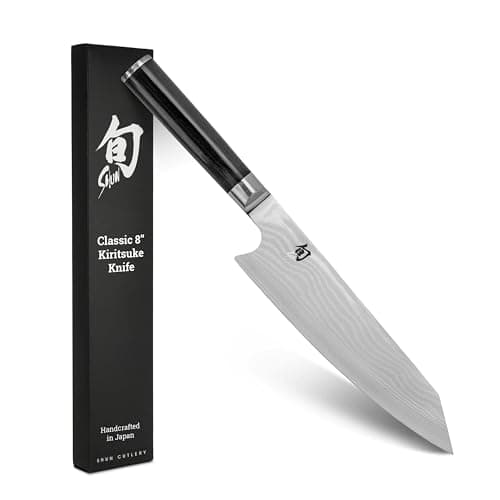
Shun
Shun Classic 8" kiritsuke, VG-MAX with 16-degree edge
See price on Amazon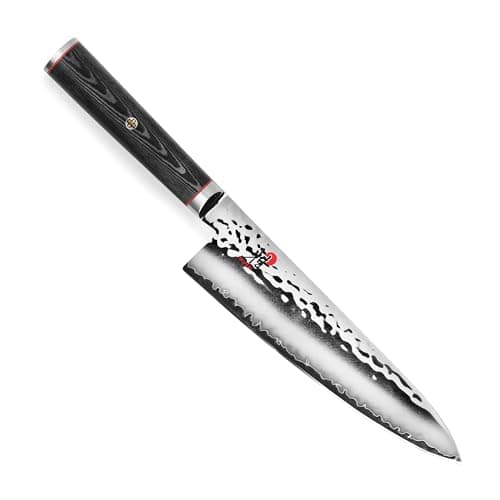
MIYABI
Miyabi Mizu SG2 8" chef's knife, 63 HRC, 12 degrees
See price on Amazon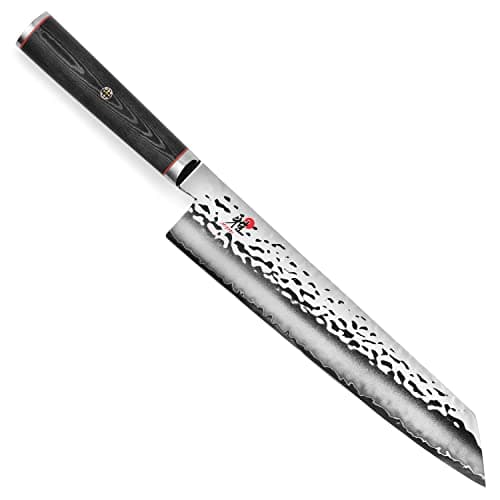
MIYABI
Miyabi Mizu SG2 9.5" kiritsuke, 63 HRC hammered blade
See price on Amazon
- Shun Classic 8 in hollow ground chef, 16-degree
- Steel
- VG-MAX, 68-layer Damascus cladding
- Hardness (HRC)
- Not stated
- Blade length
- 8 in
- Edge angle
- 16 degrees
- Shun Classic 8" kiritsuke, VG-MAX with 16-degree edge
- Steel
- VG-MAX core, 68-layer Damascus cladding
- Hardness (HRC)
- Not stated
- Blade length
- 8 in
- Edge angle
- 16 degrees
- Miyabi Mizu SG2 8" chef's knife, 63 HRC, 12 degrees
- Steel
- SG2 micro-carbide powder stainless
- Hardness (HRC)
- 63
- Blade length
- 8 in
- Edge angle
- 12 degrees, double bevel
- Miyabi Mizu SG2 9.5" kiritsuke, 63 HRC hammered blade
- Steel
- SG2 micro-carbide powder stainless
- Hardness (HRC)
- 63
- Blade length
- 9.5 in
- Edge angle
- 12 degrees, double bevel
| Pick | Steel | Hardness (HRC) | Blade length | Edge angle | Price | Link |
|---|---|---|---|---|---|---|
| Shun Classic 8 in hollow ground chef, 16-degree | VG-MAX, 68-layer Damascus cladding | Not stated | 8 in | 16 degrees | - | Amazon |
| Shun Classic 8" kiritsuke, VG-MAX with 16-degree edge | VG-MAX core, 68-layer Damascus cladding | Not stated | 8 in | 16 degrees | - | Amazon |
| Miyabi Mizu SG2 8" chef's knife, 63 HRC, 12 degrees | SG2 micro-carbide powder stainless | 63 | 8 in | 12 degrees, double bevel | - | Amazon |
| Miyabi Mizu SG2 9.5" kiritsuke, 63 HRC hammered blade | SG2 micro-carbide powder stainless | 63 | 9.5 in | 12 degrees, double bevel | - | Amazon |
Facts are taken from each Amazon listing. Prices are checked daily and shown with their date.
Verdict
Buy a gyuto such as the Shun Classic 8" or Miyabi Mizu 8" if you want one knife that rocks, slices and push cuts with a sturdier tip. Buy a kiritsuke such as the Shun Classic 8" or Miyabi Mizu 9.5" if you push cut, want a long flat edge and fine tip control, and will treat the tip gently.
This page is for cooks who have seen the angled tip of a kiritsuke and wonder whether it beats a regular gyuto. We compare the two shapes on profile, flat spot, tip strength and everyday use, using matched pairs from the Shun Classic and Miyabi Mizu SG2 lines so the steel and handle stay the same. We also explain the difference between the traditional single-bevel kiritsuke and the double-bevel version sold to home cooks.
Two kinds of kiritsuke
The traditional kiritsuke is a single-bevel knife that combines features of the yanagiba slicer and the usuba vegetable knife. In Japanese kitchens it is associated with experienced chefs because a single-bevel edge takes skill to use and sharpen. Our what is a kiritsuke knife page explains its background.
The kiritsuke sold by Shun, Miyabi and most Western retailers is double beveled, sharpened on both sides like a gyuto. It borrows the angled tip and flatter profile but is used like a chef's knife. That double-bevel version is what this comparison covers. The Miyabi Mizu kiritsuke listing, for example, specifies a 12 degree double bevel edge.
50/50 double bevel
Same bevel on both sides. Most Western and many Japanese knives.
70/30 asymmetric
Wider bevel on one side, usually the right. Common on Japanese gyuto.
Single bevel with ura
One bevel and a slightly hollow back. Yanagiba, deba and usuba.
Profile and flat spot
The gyuto's edge rises in a steady curve from roughly the middle of the blade to the tip. That belly lets you rock the knife for mincing. The kiritsuke's edge stays flat for most of its length and rises only near the tip, giving a long flat spot.
A long flat spot keeps more edge in contact with the board on each push cut, so carrots and celery separate cleanly without accordion cuts. The cost is that rocking feels clunky, because the knife has little curve to roll on. If you already push cut or use a forward slice, the kiritsuke feels natural. If you rock, stay with a gyuto.
牛刀Gyuto
180 to 270 mm
三徳Santoku
165 to 180 mm
菜切Nakiri
160 to 180 mm
文化Bunka
165 to 180 mm
切付Kiritsuke
210 to 270 mm
筋引Sujihiki
240 to 300 mm
ペティPetty
120 to 150 mm
Matched pairs from the listings
Within each brand the steel, edge angle and handle are the same, so the comparison comes down to shape and length.
Shun Classic 8" Chef's (hollow ground)
- Length
- 8 in
- Steel
- VG-MAX, 68-layer Damascus
- Hardness
- Not listed
- Edge per side
- 16 degrees
- Handle
- D-shaped Pakkawood
Shun Classic 8" Kiritsuke
- Length
- 8 in
- Steel
- VG-MAX, 68-layer Damascus
- Hardness
- Not listed
- Edge per side
- 16 degrees
- Handle
- D-shaped Pakkawood
Miyabi Mizu SG2 8" Chef's
- Length
- 8 in
- Steel
- SG2 powder steel, tsuchime
- Hardness
- HRC 63
- Edge per side
- 12 degrees
- Handle
- D-shaped Micarta
Miyabi Mizu SG2 9.5" Kiritsuke
- Length
- 9.5 in
- Steel
- SG2 powder steel, tsuchime
- Hardness
- HRC 63
- Edge per side
- 12 degrees
- Handle
- D-shaped Micarta
| Knife | Length | Steel | Hardness | Edge per side | Handle |
|---|---|---|---|---|---|
| Shun Classic 8" Chef's (hollow ground) | 8 in | VG-MAX, 68-layer Damascus | Not listed | 16 degrees | D-shaped Pakkawood |
| Shun Classic 8" Kiritsuke | 8 in | VG-MAX, 68-layer Damascus | Not listed | 16 degrees | D-shaped Pakkawood |
| Miyabi Mizu SG2 8" Chef's | 8 in | SG2 powder steel, tsuchime | HRC 63 | 12 degrees | D-shaped Micarta |
| Miyabi Mizu SG2 9.5" Kiritsuke | 9.5 in | SG2 powder steel, tsuchime | HRC 63 | 12 degrees | D-shaped Micarta |
Tip strength and detail work
The kiritsuke's clipped tip ends in a fine point near the spine line. It is excellent for scoring fish skin, making shallow cuts in onions, and julienne work at the front of the knife. Because the point is thin and sits far from the heel, it is also easier to snap if it hits the board hard or is used to pry.
A gyuto's point is more centered and backed by a bit more steel, so it tolerates a little more abuse. On harder steels such as SG2 at HRC 63, treat either tip gently. If you do break one, see broken knife tip fix.
Note.Never use the tip of a hard Japanese knife to pry open packaging or separate frozen food. Tips on HRC 61+ blades can snap rather than bend.
Length and handling
Kiritsukes are often sold longer than the matching chef's knife. The Mizu kiritsuke is 9.5 inches against 8 inches for the Mizu chef's knife. A longer blade gives a longer slicing stroke, which helps with boneless proteins and large vegetables, but it needs a larger board and more confidence.
Shun's Classic kiritsuke is 8 inches, the same as the Classic chef's knife, so it is a fair swap if you want the flat profile without extra length. Check our what size chef knife do I need guide against your board.
Which should you buy
Most home cooks should start with a gyuto. It handles every cutting style and has the sturdier tip. Our best gyuto knives guide has picks at 210 and 240 mm.
A double-bevel kiritsuke is a good choice if you already push cut, you prep a lot of vegetables and boneless protein, and you want precise tip work. It also makes a striking second knife next to a gyuto. If you are comparing a kiritsuke with a santoku instead, our gyuto vs santoku page covers the shorter all-rounder.
Frequently asked questions
Is a kiritsuke only for master chefs? The traditional single-bevel kiritsuke is a professional tool. The double-bevel versions from Shun and Miyabi are made for home cooks and sharpen like any chef's knife.
Can you rock chop with a kiritsuke? Only a little. Its flat edge makes rocking awkward; it works best with push cuts and pull slices.
Santoku vs kiritsuke: which is better? A santoku is shorter with a rounded tip and suits small boards. A kiritsuke is longer with a pointed angled tip and suits long slices and fine tip work.
How do I sharpen a kiritsuke? Like a gyuto, at the maker's angle. Lift the handle slightly near the tip so the angled section stays in contact with the stone. See how to sharpen on a whetstone.
What you need for this
- See price on AmazonAmazon
Miyabi Mizu SG2 9.5" kiritsuke, 63 HRC hammered blade
 See price on AmazonAmazon
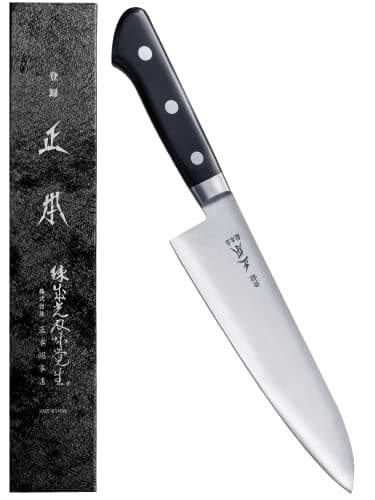
Masamoto VG 240 mm gyuto, HRC 58-59, POM handle
From Best gyuto knives: Japanese chef knives in 210 and 240 mm
- See price on AmazonAmazon
Shun Classic 8 in hollow ground chef, 16-degree
From Best Shun knives: Classic, Premier, Dual Core, Sora and Kanso
 See price on AmazonAmazon
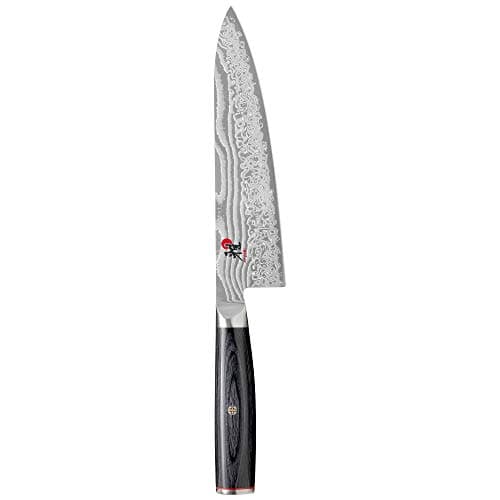
Miyabi Kaizen II 8" chef's knife, FC61 at 61 HRC
From Best Miyabi knives: Kaizen II, Mizu, Koh, Koya, Artisan, Birchwood and Black