Explainer
What is a bunka knife and what is it for
Published
Short answer
A bunka is a Japanese all-purpose kitchen knife, usually 165 to 180 mm long, with a tall blade, a fairly flat edge and an angled, pointed tip often called a reverse tanto or k-tip. It does the same everyday work as a santoku (slicing, dicing and mincing vegetables, meat and fish) but the sharp angled tip adds precision for fine cuts and scoring.
Picks for this job
All 8 picks compared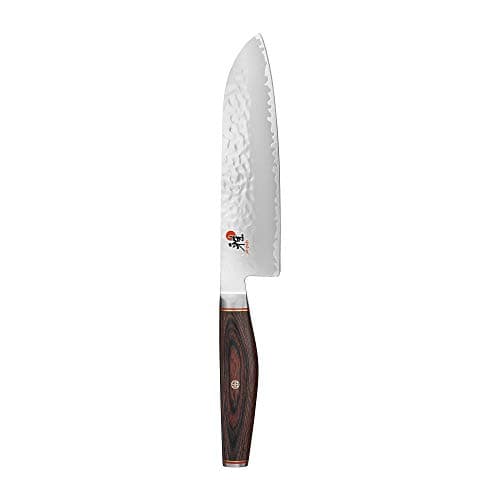
Miyabi Artisan 7" santoku in SG2 at 63 HRC
See price on AmazonSee it on Amazon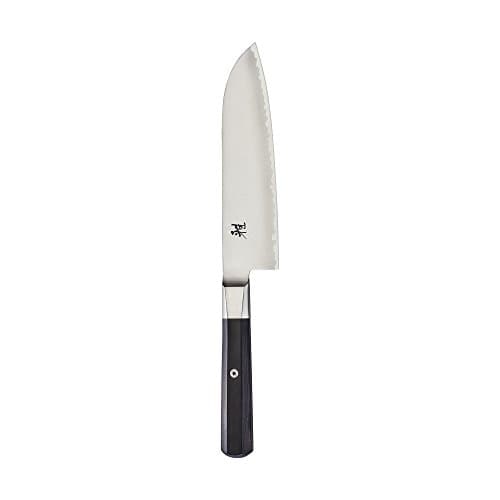
Miyabi Koh 7" santoku, FC61 steel at 61 HRC
See price on AmazonSee it on Amazon
Wusthof Classic Ikon 7" hollow-edge santoku, German
See price on AmazonSee it on Amazon
This page is for home cooks who have seen the bunka on Japanese knife sites and wonder whether it is a real category or just a styled santoku. It explains what bunka means, where the shape came from, what the knife is good at, where it falls short, and how it compares with a santoku, a gyuto and a nakiri. It ends with simple guidance on who should pick a bunka as a main knife.
What bunka means and where the knife came from
Bunka bocho is usually translated as "culture knife." The word bunka (culture) was popular in Japan in the decades when Western ideas and cooking were spreading into home kitchens, and products that blended Japanese and Western design were often labeled that way. The bunka and the santoku both grew out of that period as home knives that could handle vegetables, meat and fish with one blade.
The santoku became the more common of the two, and for a long time the bunka was a niche shape made mainly by smaller workshops. Interest has grown again in recent years, and many Japanese makers now offer a bunka alongside their gyuto and santoku. Exact origin dates vary by source, so treat any precise history claim on a listing with some caution.
牛刀Gyuto
180 to 270 mm
三徳Santoku
165 to 180 mm
菜切Nakiri
160 to 180 mm
文化Bunka
165 to 180 mm
切付Kiritsuke
210 to 270 mm
筋引Sujihiki
240 to 300 mm
ペティPetty
120 to 150 mm
The bunka shape: flat edge and reverse tanto tip
Three features define a bunka. First, the blade is tall at the heel, often similar to a santoku, which gives knuckle clearance and makes it easy to scoop food off the board. Second, the edge is fairly flat with only a slight curve toward the tip, which suits push cuts and chopping rather than heavy rocking. Third, the spine drops to meet the edge at a sharp angle, forming a clipped point. That tip is the reverse tanto or k-tip, and it is the main visual difference from a santoku's rounded sheep's foot point.
Most bunkas are double bevel and work for right and left hands. Lengths of 165 to 180 mm are typical, which is about 6.5 to 7 inches. Many are sold with a wa (Japanese) handle, though Western-handled versions exist too.
What a bunka knife is used for
A bunka is an all-purpose knife for home cooking. The flat section handles chopping and push cutting, and the pointed tip handles the detail work that a santoku can struggle with.
- Dicing onions, shallots and peppers with clean horizontal and vertical cuts using the tip.
- Push cutting and chopping vegetables such as carrots, cucumbers and cabbage.
- Fine julienne and brunoise, where the flat edge keeps full contact with the board.
- Mincing herbs and garlic with a tap-chop motion.
- Slicing boneless chicken, pork and fish fillets.
- Scoring meat, trimming fat and cutting small items with the tip.
Note.The angled tip is thin and fine. Do not use it to pry, to pierce hard squash or to stab into frozen food, or it can snap. See broken knife tip fixes if that happens.
Bunka vs santoku vs gyuto vs nakiri
The bunka sits between a santoku and a small gyuto. It is about the same length and height as a santoku, but with a pointed tip that behaves more like a gyuto's. A nakiri, by contrast, has no point at all and is a vegetable specialist. Our gyuto vs bunka and nakiri vs santoku pages give fuller comparisons.
Bunka
- Typical length
- 165-180 mm
- Tip
- Angled reverse tanto
- Edge profile
- Mostly flat
- Best at
- All-purpose with tip precision
Santoku
- Typical length
- 165-180 mm
- Tip
- Rounded sheep's foot
- Edge profile
- Mostly flat
- Best at
- All-purpose, compact
Gyuto
- Typical length
- 180-270 mm
- Tip
- Pointed
- Edge profile
- Gentle curve
- Best at
- All-purpose, long strokes
Nakiri
- Typical length
- 165-180 mm
- Tip
- Square, no point
- Edge profile
- Flat
- Best at
- Vegetables only
| Knife | Typical length | Tip | Edge profile | Best at |
|---|---|---|---|---|
| Bunka | 165-180 mm | Angled reverse tanto | Mostly flat | All-purpose with tip precision |
| Santoku | 165-180 mm | Rounded sheep's foot | Mostly flat | All-purpose, compact |
| Gyuto | 180-270 mm | Pointed | Gentle curve | All-purpose, long strokes |
| Nakiri | 165-180 mm | Square, no point | Flat | Vegetables only |
Pros and cons of a bunka
The main advantage is that a bunka gives you a compact knife with a usable point. On a small board or in a small kitchen, it handles the same range of jobs as a longer gyuto without feeling unwieldy. The tall blade guides your knuckles, and the flat edge keeps cuts clean on a push stroke.
The trade-offs are modest. The short length limits long slicing strokes on big roasts or large fish, and the fine tip is more fragile than a santoku's rounded point. A flatter edge also makes rocking cuts feel abrupt if you learned on a curved German knife. Prices for bunkas are often a little higher than for a santoku in the same line, because the shape is made in smaller numbers.
- Pro: compact size that is easy to control on small boards.
- Pro: pointed tip for detail work a santoku cannot do as well.
- Pro: tall blade for knuckle clearance and scooping.
- Con: shorter stroke than a 210 or 240 mm gyuto.
- Con: thin angled tip needs care.
- Con: fewer models to choose from than gyutos or santokus.
Who should buy a bunka
A bunka is a good main knife if you cook mostly vegetables and boneless proteins, work on a board under about 16 inches wide, or simply prefer a shorter knife but want a sharper point than a santoku offers. It also makes a nice second knife beside a 240 mm gyuto, covering quick prep jobs where the long blade feels like too much.
If you often slice large roasts or want a single knife for everything, a 210 mm gyuto is the more flexible choice. Pair either with a petty knife for small work. The santoku guide and the best Japanese kitchen knives list cover the shapes most home cooks pick from.
Caring for a bunka
Care is the same as for any thin Japanese blade. Hand wash and dry it right away, use a wood or soft synthetic board, and store it with the tip protected in a saya, a block or on a wood-faced magnetic strip. Our page on how to store Japanese knives covers each option. When you sharpen, keep the tip on the stone by lifting the handle slightly as you reach the angled section, so the point does not get rounded over time.
Frequently asked questions
Is a bunka better than a santoku? Neither is better overall. A bunka adds a pointed tip for detail cuts; a santoku has a sturdier rounded tip. Pick the bunka if you value precision and the santoku if you want a more forgiving point.
Can a bunka replace a chef knife? For most home cooking, yes. It is shorter than a typical chef knife, so long slicing jobs take more strokes, but it handles daily prep well.
Is a bunka good for left-handed cooks? Most bunkas are double bevel and fine for either hand. Check that the handle is octagonal or oval rather than a right-handed D shape. See left-handed Japanese knives.
What does k-tip mean? It is another name for the clipped, angled point on a bunka or kiritsuke, so called because the profile resembles the letter K turned sideways.
What you need for this
- See price on AmazonAmazon
Miyabi Artisan 7" santoku in SG2 at 63 HRC
 See price on AmazonAmazon
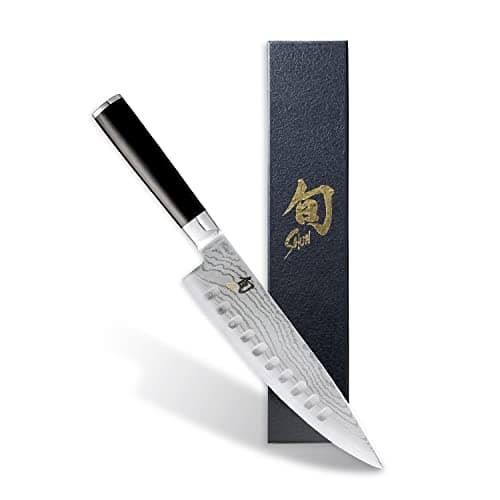
Shun Classic 8 in hollow ground chef, 16-degree
From Best Japanese kitchen knives for home cooks: one pick per job
 See price on AmazonAmazon
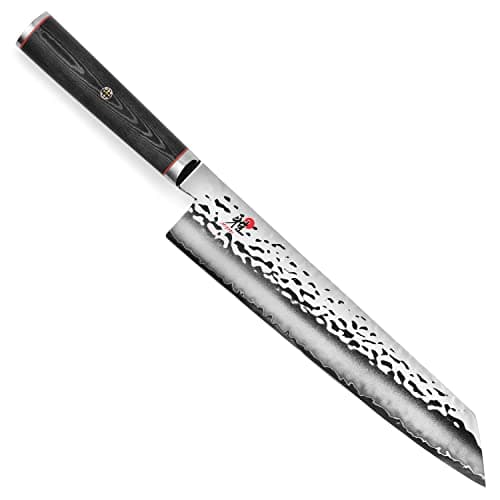
Miyabi Mizu SG2 9.5" kiritsuke, 63 HRC hammered blade