Comparison
Nakiri vs santoku for vegetable prep
Published
Short answer
A nakiri is a dedicated vegetable knife with a dead-flat edge and a squared-off tip, so every chop meets the board along its full length. A santoku is an all-purpose knife with a mostly flat edge, a slight curve near the front and a rounded point, so it also handles meat, fish and some tip work. Buy a santoku if you want one knife for everything; add a nakiri if you prep large amounts of vegetables and already own an all-rounder.
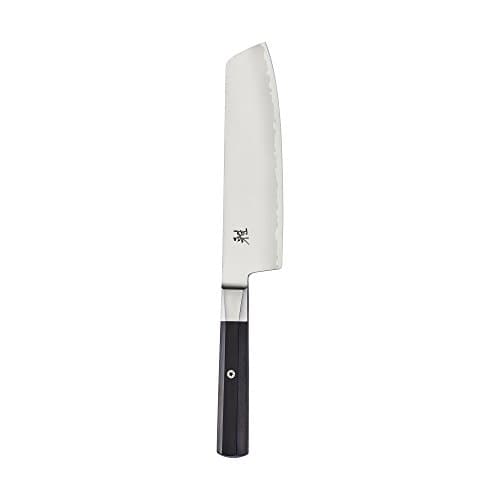
MIYABI
Miyabi Koh 6.5" nakiri, FC61 steel at the lowest price
See price on Amazon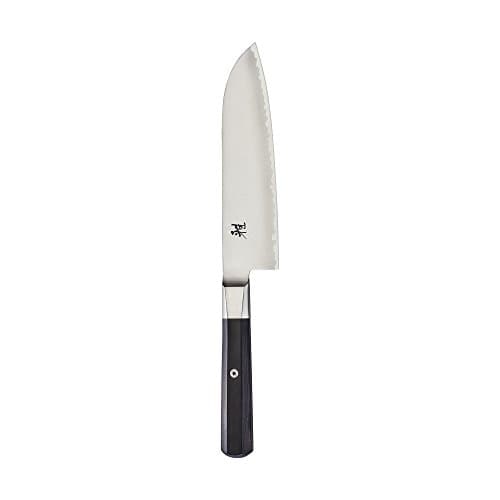
MIYABI
Miyabi Koh 7 in santoku, FC61 at 61 HRC
See price on Amazon
- Miyabi Koh 6.5" nakiri, FC61 steel at the lowest price
- Steel
- FC61 fine carbide stainless
- Hardness (HRC)
- 61
- Blade length
- 6.5 in
- Edge angle
- 9.5-12 degrees
- Miyabi Koh 7 in santoku, FC61 at 61 HRC
- Steel
- FC61 fine carbide stainless
- Hardness (HRC)
- 61
- Blade length
- 7 in
- Edge angle
- 9.5-12 degrees
| Pick | Steel | Hardness (HRC) | Blade length | Edge angle | Price | Link |
|---|---|---|---|---|---|---|
| Miyabi Koh 6.5" nakiri, FC61 steel at the lowest price | FC61 fine carbide stainless | 61 | 6.5 in | 9.5-12 degrees | - | Amazon |
| Miyabi Koh 7 in santoku, FC61 at 61 HRC | FC61 fine carbide stainless | 61 | 7 in | 9.5-12 degrees | - | Amazon |
Facts are taken from each Amazon listing. Prices are checked daily and shown with their date.
Verdict
Buy the Miyabi Koh santoku if you want one knife for vegetables, meat and fish. Buy the Miyabi Koh nakiri as a second knife, or as your main blade if your cooking is mostly vegetables and you keep a small petty for point work.
This page is for home cooks who prep a lot of produce and are weighing a nakiri against a santoku, or wondering whether a nakiri is worth adding next to the santoku or chef knife they already have. It compares the two shapes on edge profile, tip, height and versatility, using a matched pair from the Miyabi Koh line so steel and handle stay the same. It also touches on the nakiri vs gyuto question, since many readers ask that next.
The short version
Both knives are Japanese home-kitchen shapes of similar length and height, and both favor push cutting and straight-down chopping over rocking. The difference is focus. The nakiri gives up the point entirely to get a perfectly flat, rectangular blade built for vegetables. The santoku keeps a small curve and a usable tip so it can also slice proteins, trim fat and handle general kitchen work.
That makes the santoku the more sensible first knife and the nakiri a specialist you add when vegetables are a big share of your cooking. Plant-forward cooks sometimes use a nakiri as their main knife and keep a small petty for point work. Our types of Japanese knives overview shows where both fit in a full lineup.
牛刀Gyuto
180 to 270 mm
三徳Santoku
165 to 180 mm
菜切Nakiri
160 to 180 mm
文化Bunka
165 to 180 mm
切付Kiritsuke
210 to 270 mm
筋引Sujihiki
240 to 300 mm
ペティPetty
120 to 150 mm
Miyabi Koh nakiri vs santoku: spec table
The Miyabi Koh nakiri and santoku share steel, hardness, edge angle and handle, so this pair isolates the shape difference. Specs come only from the listings.
Blade length
- Miyabi Koh Nakiri
- 6.5 inch
- Miyabi Koh Santoku
- 7 inch
Steel
- Miyabi Koh Nakiri
- FC61 fine carbide stainless
- Miyabi Koh Santoku
- FC61 fine carbide stainless
Hardness
- Miyabi Koh Nakiri
- 61 Rockwell
- Miyabi Koh Santoku
- 61 Rockwell
Edge angle
- Miyabi Koh Nakiri
- 9.5-12 degrees
- Miyabi Koh Santoku
- 9.5-12 degrees
Heat treatment
- Miyabi Koh Nakiri
- Ice-hardened FRIODUR x2
- Miyabi Koh Santoku
- Ice-hardened FRIODUR x2
Handle
- Miyabi Koh Nakiri
- Not stated in listing
- Miyabi Koh Santoku
- Pakkawood, octagon-shaped
Made in
- Miyabi Koh Nakiri
- Seki, Japan, handcrafted
- Miyabi Koh Santoku
- Seki, Japan, handcrafted
| Spec | Miyabi Koh Nakiri | Miyabi Koh Santoku |
|---|---|---|
| Blade length | 6.5 inch | 7 inch |
| Steel | FC61 fine carbide stainless | FC61 fine carbide stainless |
| Hardness | 61 Rockwell | 61 Rockwell |
| Edge angle | 9.5-12 degrees | 9.5-12 degrees |
| Heat treatment | Ice-hardened FRIODUR x2 | Ice-hardened FRIODUR x2 |
| Handle | Not stated in listing | Pakkawood, octagon-shaped |
| Made in | Seki, Japan, handcrafted | Seki, Japan, handcrafted |
Flat edge vs slight belly
The nakiri's edge is straight from heel to tip. When you chop down, the whole edge meets the board at the same moment, so a pile of scallions, a row of celery or a halved cabbage separates fully with no strands left joined. That flat contact is the main reason vegetable-heavy cooks love the shape. It also means you cannot rock a nakiri; it is a push-cut and chop knife only.
The santoku is mostly flat but sweeps up near the front. That small curve lets you slice with a forward draw and do a little rocking for herbs, and it lifts the front of the blade so you can work the tip. On vegetables it performs nearly as well as a nakiri for most home prep, with occasional uncut connections on long items. Read more in what is a nakiri used for and what is a santoku used for.
Tip, height and versatility
A nakiri has no real point. The front is squared off or slightly rounded, which makes it safe and stable but useless for tasks like scoring, coring or trimming silver skin. A santoku's sheep's foot tip is not as fine as a gyuto's point, but it still handles light detail work, so one santoku can cover most of a home kitchen.
Both blades are tall at the heel, which gives knuckle clearance and lets you scoop chopped food off the board. The nakiri's rectangular shape keeps that height all the way to the front, so it works as a better scoop. For meat and fish, the santoku is the clear winner: its point and slight belly make slicing chicken breasts or portioning fish much easier than with a flat vegetable blade.
- Choose a nakiri for: large batches of vegetables, fine julienne and brunoise, cabbage and greens, plant-based cooking.
- Choose a santoku for: one-knife kitchens, mixed vegetable and protein prep, light tip work.
- Own both if: you cook vegetables daily and want a dedicated tool plus an all-rounder.
Nakiri vs gyuto
A gyuto is the Japanese chef knife: longer, typically 210 or 240 mm, with a curved belly and a sharp point. It does everything a santoku does plus long slicing and rock-chopping. Against a nakiri, the gyuto is far more versatile, while the nakiri is more efficient for straight chopping of vegetables and easier to control on a small board.
A common setup is a gyuto as the main knife with a nakiri for vegetable sessions, or a santoku plus a nakiri for cooks who prefer shorter blades. Thin Japanese edges like the 9.5 to 12 degree edge on the Miyabi Koh are excellent on produce but should stay away from bones and frozen food. Our gyuto guide and santoku guide list options in both shapes.
Note.Very thin vegetable knives can chip if you chop through hard squash rinds with a twisting motion. Cut straight down and let the blade do the work.
Frequently asked questions
Is a nakiri worth it if I already have a santoku? It is worth it if you prep a lot of vegetables and want cleaner, faster chopping. If vegetables are only a small part of your cooking, the santoku already covers them well.
Can a nakiri cut meat? It can slice boneless meat, but the flat edge and missing tip make it awkward. A santoku or gyuto handles meat and fish much better.
Is a nakiri the same as an usuba? No. A nakiri is double bevel and made for home cooks; an usuba is a single-bevel professional vegetable knife that takes more skill to use and sharpen. See nakiri vs usuba.
Which is easier to sharpen? The nakiri, because its flat edge has no curve to follow on the stone. Our whetstone sharpening guide covers both shapes.
What you need for this
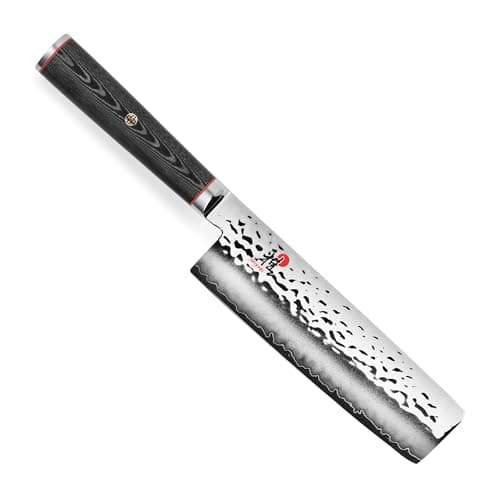 See price on AmazonAmazon
Miyabi Mizu SG2 6.5" nakiri, 63 HRC, 12-degree edge
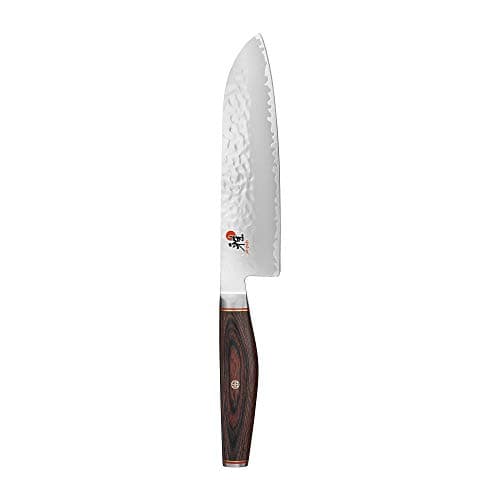 See price on AmazonAmazon
Miyabi Artisan 7" santoku in SG2 at 63 HRC
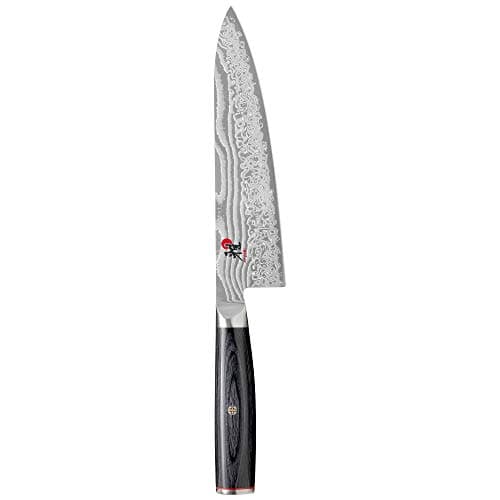 See price on AmazonAmazon
Miyabi Kaizen II 8" chef's knife, FC61 at 61 HRC
From Best Miyabi knives: Kaizen II, Mizu, Koh, Koya, Artisan, Birchwood and Black
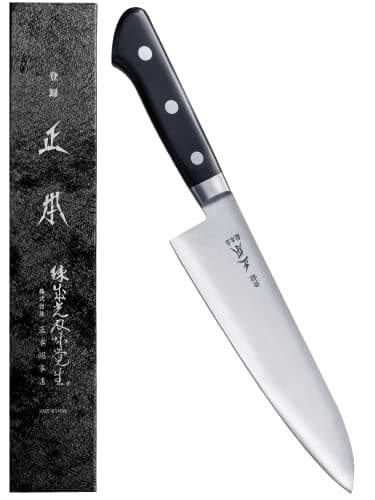 See price on AmazonAmazon
Masamoto VG 240 mm gyuto, HRC 58-59, POM handle
From Best gyuto knives: Japanese chef knives in 210 and 240 mm