Comparison
Nakiri vs usuba: double vs single bevel vegetable knives
Published
Short answer
A nakiri and an usuba look alike: both are rectangular Japanese vegetable knives with flat edges. The nakiri is double beveled, sharpened on both sides, so it cuts straight for right or left-handed cooks and is easy to sharpen. The usuba is single beveled with a flat back, built for professional techniques like katsuramuki thin sheets, and needs skill to use and sharpen. Home cooks should buy a nakiri.
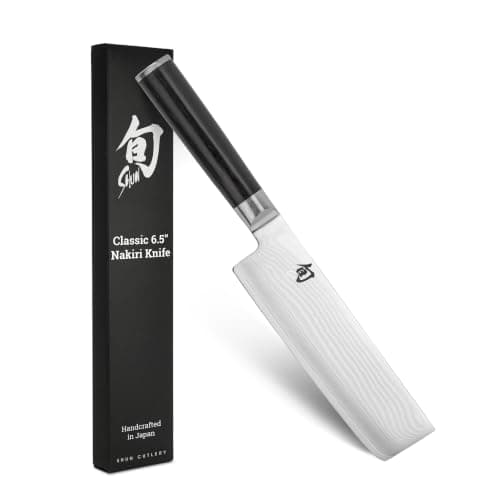
Shun
Shun Classic 6.5" nakiri for flat vegetable cuts
See price on Amazon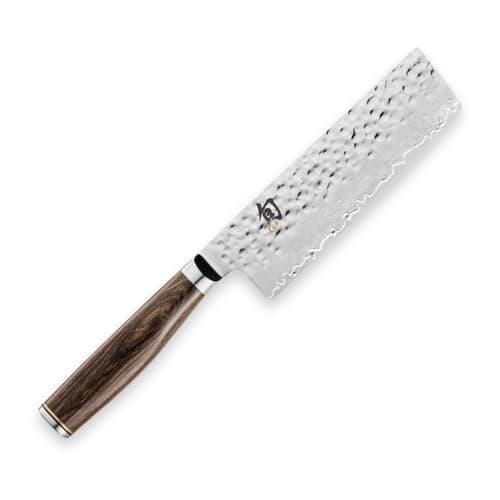
Shun
Shun Premier 5.5" nakiri with hammered tsuchime finish
See price on Amazon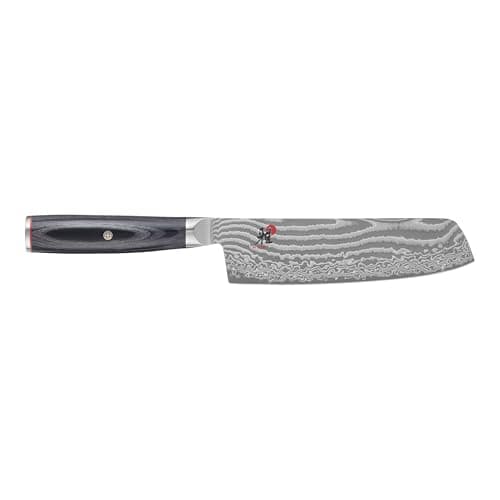
MIYABI
Miyabi Kaizen II 6.5" nakiri, FC61 at 61 HRC
See price on Amazon
- Shun Classic 6.5" nakiri for flat vegetable cuts
- Steel
- VG-MAX core, 68-layer Damascus cladding
- Hardness (HRC)
- Not stated
- Blade length
- 6.5 in
- Edge angle
- 16 degrees
- Shun Premier 5.5" nakiri with hammered tsuchime finish
- Steel
- VG-MAX core, 68-layer Damascus cladding
- Hardness (HRC)
- Not stated
- Blade length
- 5.5 in
- Edge angle
- 16 degrees
- Miyabi Kaizen II 6.5" nakiri, FC61 at 61 HRC
- Steel
- FC61 core, 48 layers of damast steel
- Hardness (HRC)
- 61
- Blade length
- 6.5 in
- Edge angle
- 9.5-12 degrees
| Pick | Steel | Hardness (HRC) | Blade length | Edge angle | Price | Link |
|---|---|---|---|---|---|---|
| Shun Classic 6.5" nakiri for flat vegetable cuts | VG-MAX core, 68-layer Damascus cladding | Not stated | 6.5 in | 16 degrees | - | Amazon |
| Shun Premier 5.5" nakiri with hammered tsuchime finish | VG-MAX core, 68-layer Damascus cladding | Not stated | 5.5 in | 16 degrees | - | Amazon |
| Miyabi Kaizen II 6.5" nakiri, FC61 at 61 HRC | FC61 core, 48 layers of damast steel | 61 | 6.5 in | 9.5-12 degrees | - | Amazon |
Facts are taken from each Amazon listing. Prices are checked daily and shown with their date.
Verdict
Home cooks should buy a nakiri: the Shun Classic 6.5" for a balanced first pick, the Shun Premier 5.5" for small boards, or the Miyabi Kaizen II 6.5" for the thinnest edge. Consider an usuba only if you are training in Japanese techniques like katsuramuki and will learn single-bevel sharpening.
This page is for cooks who want a dedicated vegetable knife and are confused by two nearly identical rectangular blades. We explain how the nakiri and usuba differ in grind, weight, handedness, sharpening and use, why the usuba is mainly a professional tool, and which nakiri models are worth a look. Our nakiri examples are the Shun Classic, Shun Premier and Miyabi Kaizen II; there is no usuba among our listed products, so we describe it from general knowledge.
The key difference is the grind
A nakiri is sharpened on both sides, like a gyuto or santoku. The edge sits in the center of the blade and the knife cuts straight down. It works the same for right and left-handed cooks if the bevels are symmetric.
An usuba is sharpened on one side only. The front face has a single bevel; the back is hollow ground (the ura) with a narrow flat rim. That geometry lets the blade glide along a vegetable to peel paper-thin sheets, but it also means the knife steers to one side unless you know how to correct for it. Usubas are made in right and left-handed versions, and the wrong one will not work for you. The diagram below draws both grinds, and our glossary defines ura and other terms.
50/50 double bevel
Same bevel on both sides. Most Western and many Japanese knives.
70/30 asymmetric
Wider bevel on one side, usually the right. Common on Japanese gyuto.
Single bevel with ura
One bevel and a slightly hollow back. Yanagiba, deba and usuba.
Nakiri vs usuba at a glance
The usuba column describes typical traditional usubas in general terms, since none are in our product list. Nakiri facts come from the listings.
Bevel
- Nakiri (listing examples)
- Double bevel
- Usuba (typical)
- Single bevel with hollow back
Handedness
- Nakiri (listing examples)
- Either hand
- Usuba (typical)
- Right or left specific
Common lengths
- Nakiri (listing examples)
- 5.5 to 6.5 in (Shun Premier 5.5", Shun Classic and Miyabi Kaizen II 6.5")
- Usuba (typical)
- Often 165 to 210 mm
Common steels
- Nakiri (listing examples)
- Stainless: VG-MAX, FC61 at HRC 61, SG2 at HRC 63
- Usuba (typical)
- Often carbon steel such as Shirogami or Aogami, clad in soft iron
Handle
- Nakiri (listing examples)
- Western or D-shaped (Pakkawood, Micarta)
- Usuba (typical)
- Usually traditional wa handle
Sharpening
- Nakiri (listing examples)
- Like any double-bevel knife
- Usuba (typical)
- Bevel side plus careful work on the ura
Who it suits
- Nakiri (listing examples)
- Home cooks
- Usuba (typical)
- Trained Japanese chefs
| Feature | Nakiri (listing examples) | Usuba (typical) |
|---|---|---|
| Bevel | Double bevel | Single bevel with hollow back |
| Handedness | Either hand | Right or left specific |
| Common lengths | 5.5 to 6.5 in (Shun Premier 5.5", Shun Classic and Miyabi Kaizen II 6.5") | Often 165 to 210 mm |
| Common steels | Stainless: VG-MAX, FC61 at HRC 61, SG2 at HRC 63 | Often carbon steel such as Shirogami or Aogami, clad in soft iron |
| Handle | Western or D-shaped (Pakkawood, Micarta) | Usually traditional wa handle |
| Sharpening | Like any double-bevel knife | Bevel side plus careful work on the ura |
| Who it suits | Home cooks | Trained Japanese chefs |
What each knife is good at
A nakiri's flat edge meets the board along its whole length, so straight up and down chopping cuts through scallions, cabbage and carrots cleanly with no accordion strips. The tall blade guides your knuckles and scoops chopped food off the board. See what is a nakiri knife used for.
An usuba does the same chopping but is built for precision work in Japanese cuisine: katsuramuki (turning a daikon against the edge to peel a continuous thin sheet), very fine julienne, and decorative cuts. The single bevel lets slices fall away cleanly with little wedging. These skills take practice, which is why the usuba is a pro tool.
- Everyday vegetable prep at home: nakiri.
- Mixed household with left and right-handed cooks: nakiri.
- Katsuramuki and Japanese garnish work: usuba.
- Low-maintenance stainless steel: nakiri (most usubas are carbon steel).
Sharpening and care
A stainless nakiri sharpens like any double-bevel Japanese knife: hold the maker's angle on each side, 16 degrees for Shun and 9.5 to 12 degrees for Miyabi Kaizen II per the listings. Our sharpening angle finder gives the spine height, and the whetstone guide walks through the strokes.
An usuba needs the large front bevel ground flat on the stone and only light passes on the back to remove the burr, without destroying the hollow. Carbon steel usubas also need wiping dry right away and develop a patina; see carbon steel knife patina and Japanese knife rust.
Note.Never twist a nakiri or usuba to pop off a squash wedge. The thin flat edge can chip. Cut through, then lift.
Nakiri picks from our list
The Shun Classic 6.5" Nakiri uses VG-MAX with 68-layer Damascus cladding, a 16 degree edge and a D-shaped Pakkawood handle. The Shun Premier 5.5" Nakiri uses the same steel and edge with a hammered tsuchime finish and a contoured handle; it is the shorter option for small boards. The Miyabi Kaizen II 6.5" Nakiri uses FC61 at HRC 61 with 48-layer Damascus and a 9.5 to 12 degree edge, the thinnest edge of the three.
For more choices including carbon steel models, see our best nakiri knives guide. If you are deciding between a nakiri and an all-rounder, read nakiri vs santoku.
Frequently asked questions
Can a left-handed cook use an usuba? Only a left-handed usuba. A right-handed usuba steers the wrong way in the left hand. Any symmetric nakiri works for both. See left-handed Japanese knives.
Is a nakiri the same as a Chinese cleaver? No. A nakiri is much thinner and lighter. Our nakiri vs Chinese cleaver page compares them.
Do I need an usuba if I make Japanese food at home? Usually not. A sharp nakiri or gyuto handles almost all home Japanese prep.
Can a nakiri cut meat? It can slice boneless meat, but it has no tip for trimming, so a gyuto or petty knife is better for meat work.
What you need for this
 See price on AmazonAmazon
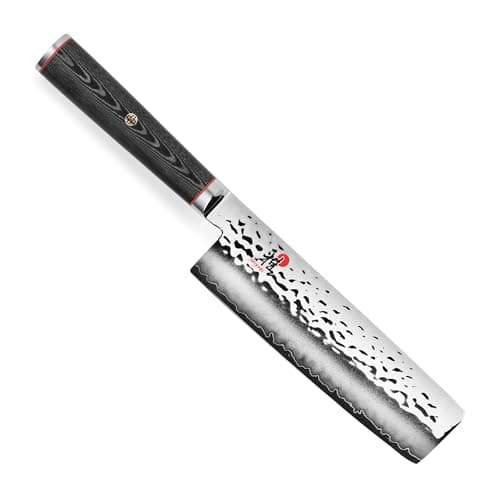
Miyabi Mizu SG2 6.5" nakiri, 63 HRC, 12-degree edge
 See price on AmazonAmazon
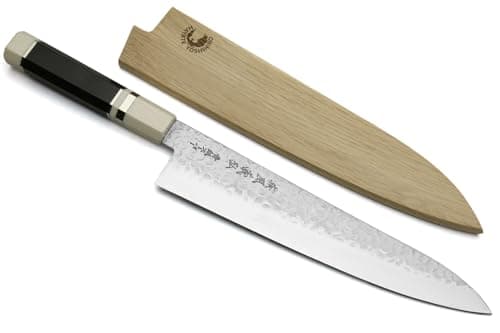
Yoshihiro Super Blue 210 mm gyuto, 63-64 HRC
 See price on AmazonAmazon
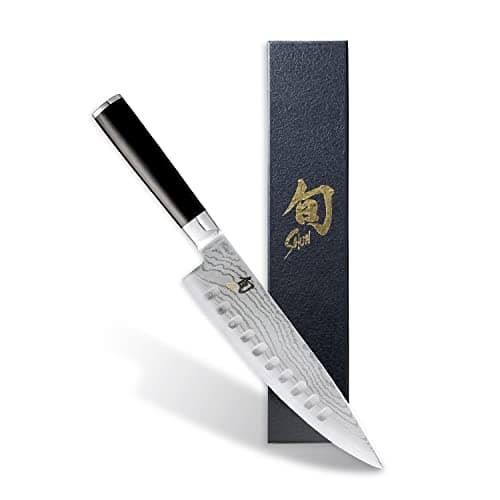
Shun Classic 8 in hollow ground chef, 16-degree
From Best Shun knives: Classic, Premier, Dual Core, Sora and Kanso