Explainer
What is a gyuto knife used for
Published
Short answer
A gyuto is the Japanese version of the Western chef knife and is used for almost every cutting job in a home kitchen: slicing vegetables, dicing onions, mincing herbs and garlic, and portioning boneless meat and fish. Compared with a German chef knife it is usually thinner, lighter and harder, with a flatter belly and a sharper, more pointed tip.
Picks for this job
All 8 picks compared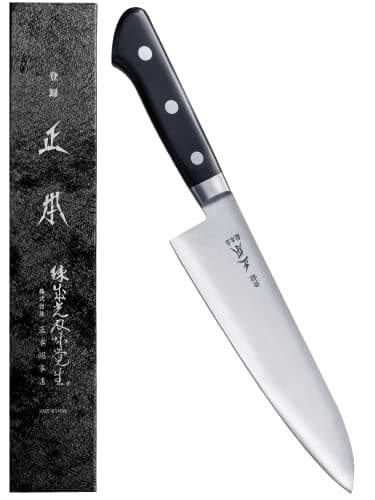
Masamoto VG 240 mm gyuto, HRC 58-59, POM handle
See price on AmazonSee it on Amazon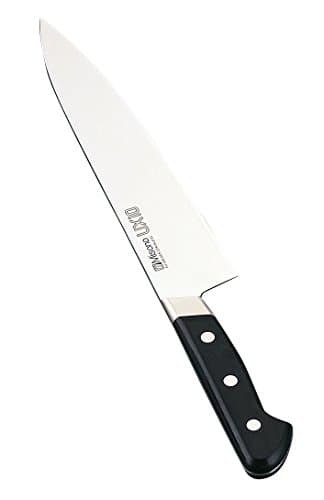
Misono UX10 210 mm gyuto in Swedish stainless
See price on AmazonSee it on Amazon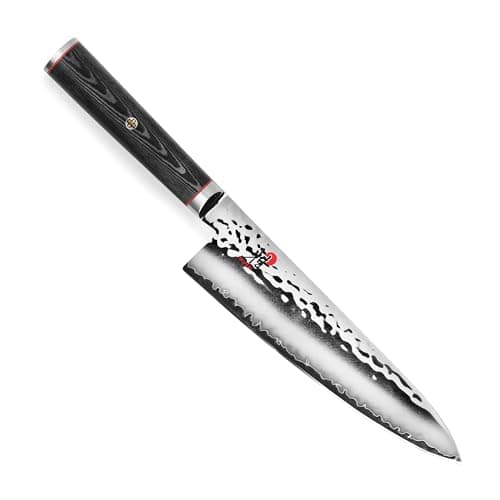
Miyabi Mizu SG2 8 in chef knife at 63 HRC
See price on AmazonSee it on Amazon
This page is for home cooks who keep seeing the word gyuto on knife listings and want to know what the knife actually does before spending money on one. It covers where the name comes from, the jobs a gyuto handles well, the jobs it should never do, how it compares with a German chef knife and a santoku, and which length suits most US kitchens. If you already know you want one, the gyuto buying guide lists models in 210 and 240 mm.
What gyuto means and where the knife came from
Gyuto (sometimes written gyutou) translates roughly as "cow sword" or "beef knife." The name comes from the late 1800s, when Japan opened to the West and cooks began working with more beef and Western-style dishes. Japanese smiths adapted the French chef knife to that cooking, then kept refining it with the thin grinds and hard steels they used for traditional knives.
Today the gyuto is the default all-purpose knife in most Japanese restaurant kitchens and the knife most people mean when they say "Japanese chef knife." Brands such as Shun, Miyabi, Global and MAC all sell gyutos, though some label them simply as chef knives on US listings. If a product page shows a long, pointed blade with a gently curved edge, it is a gyuto whatever the box says.
- Tip
- The point, for fine work
- Belly
- The curve of the edge, for rocking cuts
- Flat
- The straight part of the edge near the heel
- Heel
- The rear corner of the edge
- Choil
- Where the edge ends at the handle
- Spine
- The thick back of the blade
- Ferrule
- The collar of a wa handle; a Western knife has a bolster
- Tang
- The steel inside the handle
- HRC
- Hardness of the steel, here 60-61
What a gyuto is used for in a home kitchen
A gyuto is designed to be the one knife that does most of the work. Its length gives room for long slicing strokes, its belly lets you rock through herbs, and its fine tip handles detail cuts. For most home cooks it replaces the 8 inch chef knife entirely.
- Slicing and dicing vegetables: onions, carrots, peppers, potatoes and celery.
- Mincing herbs, garlic, shallots and ginger with a light rocking or tap-chop motion.
- Slicing boneless meat: chicken breast, steak, pork loin and roasts off the bone.
- Portioning boneless fish fillets and slicing salmon for cooking.
- Fine tip work: scoring, trimming silver skin and cutting small items like shallots in half.
- Breaking down large soft produce such as cabbage, melons with soft rinds and squash with care.
Note.Because a gyuto is thin and hard, cut straight through the food and avoid twisting the blade in dense items like winter squash. Twisting is a common way to chip a thin edge.
What not to use a gyuto for
The same thin edge that makes a gyuto glide through food makes it vulnerable to impact and side loads. Most chips on Japanese knives come from jobs the knife was never meant to do. Keep a cheap utility knife or a cleaver around for these tasks, and see the guide to a chipped Japanese knife if the damage has already happened.
- Chopping through bones, joints or poultry backbones.
- Cutting frozen food or splitting blocks of frozen meat.
- Prying open containers, cracking lobster shells or splitting hard rinds.
- Scraping food off the board with the edge (flip the knife and use the spine).
- Cutting on glass, stone, ceramic or marble boards.
Gyuto vs German chef knife
Both knives do the same jobs, but they are built with different priorities. German chef knives from brands like Wusthof and Zwilling use softer, tougher stainless steel, thicker blades and a more curved belly that favors a rocking cut. A gyuto trades some toughness for a keener, longer-lasting edge and less weight.
In practice a gyuto falls through onions and carrots with less wedging and needs sharpening less often, while a German knife shrugs off rough handling and is easier to straighten with a honing steel. For a full comparison, read Japanese vs German knives, or check the steel chart to compare the hardness of specific series.
Typical hardness
- Gyuto
- HRC 60-64
- German chef knife
- HRC 56-58
Edge angle per side
- Gyuto
- About 10-16 degrees
- German chef knife
- About 14-15 degrees
Blade thickness
- Gyuto
- Thin behind the edge
- German chef knife
- Thicker, heavier
Profile
- Gyuto
- Flatter belly, pointed tip
- German chef knife
- More curve for rocking
Handle
- Gyuto
- Wa (Japanese) or Western
- German chef knife
- Western, full tang
Strength
- Gyuto
- Clean, precise cuts
- German chef knife
- Toughness and forgiveness
| Feature | Gyuto | German chef knife |
|---|---|---|
| Typical hardness | HRC 60-64 | HRC 56-58 |
| Edge angle per side | About 10-16 degrees | About 14-15 degrees |
| Blade thickness | Thin behind the edge | Thicker, heavier |
| Profile | Flatter belly, pointed tip | More curve for rocking |
| Handle | Wa (Japanese) or Western | Western, full tang |
| Strength | Clean, precise cuts | Toughness and forgiveness |
Gyuto vs santoku and other Japanese shapes
The santoku is the other common Japanese all-purpose knife. It is shorter (usually 165 to 180 mm), taller at the heel and has a rounded sheep's foot tip, which makes it compact and friendly on small boards. The gyuto is longer and has a true pointed tip, so it handles larger produce, long slicing strokes and tip work better. Our gyuto vs santoku page goes deeper.
A kiritsuke or bunka adds an angled tip and a flatter edge, and a nakiri is a dedicated vegetable knife with no point at all. If you are still sorting the shapes out, the overview of types of Japanese knives and the page on what a bunka knife is cover them side by side.
Which gyuto length to choose
Gyutos are sold in millimeters. The 210 mm size is about 8.3 inches, close to the standard 8 inch chef knife, and it is the easiest starting point for most home cooks. A 240 mm gyuto (about 9.4 inches) gives longer strokes and more room for big produce, and many people who cook a lot grow into it, but it needs a board at least 18 inches wide to feel comfortable.
Sizes of 180 mm suit small kitchens and smaller hands, while 270 mm and longer are mostly restaurant tools. If you are unsure, start with 210 mm. Our page on what size chef knife you need explains how board size and hand size factor in.
How to keep a gyuto cutting well
A gyuto stays sharp longest when it is used on a wood or soft synthetic board, hand washed, dried right away and stored so the edge does not bang against other tools. Never put it in the dishwasher. If the blade is carbon steel, wipe it dry during prep as well, not only at the end.
When it starts to slip on tomato skins, it is time to sharpen. Most double-bevel gyutos come with an edge somewhere around 10 to 16 degrees per side depending on the brand; the sharpening angle finder gives factory angles by brand. A whetstone in the 1000 grit range handles routine sharpening, as explained in the whetstone grit guide.
Frequently asked questions
Is a gyuto the same as a chef knife? Yes, in function. A gyuto is the Japanese form of the chef knife. It is usually lighter, thinner and harder than a German chef knife, with a flatter edge and a sharper tip.
Can a gyuto cut meat? Yes. It is excellent for slicing boneless meat and fish, which is where the name "beef knife" comes from. Do not use it to cut through bones or frozen meat.
Is a gyuto good for beginners? A 210 mm gyuto with a stainless core steel is a fine first Japanese knife. Learn to cut straight down or with a push cut instead of twisting, and it will last for years. See the list of Japanese knives for beginners.
Gyuto or santoku for a small kitchen? If your board is under 15 inches wide, a santoku or a 180 mm gyuto is easier to manage. On a standard board, a 210 mm gyuto is more versatile.
What you need for this
- See price on AmazonAmazon
Masamoto VG 240 mm gyuto, HRC 58-59, POM handle
From Best gyuto knives: Japanese chef knives in 210 and 240 mm
 See price on AmazonAmazon
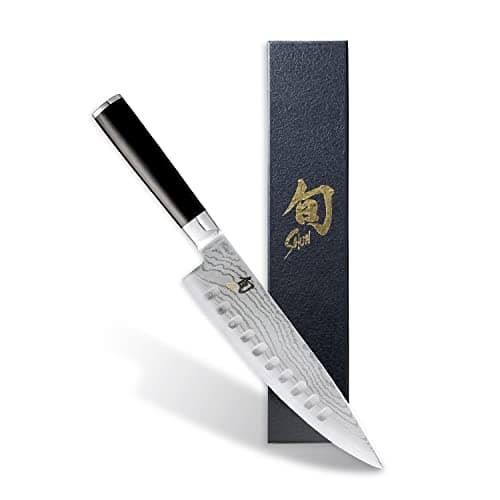
Shun Classic 8 in hollow ground chef, 16-degree
From Best Japanese kitchen knives for home cooks: one pick per job