Comparison
VG-10 vs SG2 steel for kitchen knives
Published
Short answer
VG-10 is a conventional stainless steel usually hardened to about HRC 60 to 61. SG2, also sold as R2, is a powder metallurgy stainless steel usually hardened to about HRC 62 to 64. SG2 holds an edge noticeably longer and can take a thinner edge, but it costs more, takes longer to sharpen and is a little more prone to chipping. VG-10 is easier to sharpen and cheaper, and it is plenty for most home cooks.
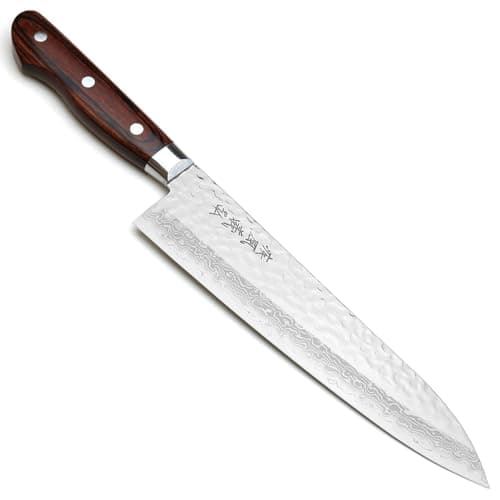
Yoshihiro
Yoshihiro VG10 16-layer 210 mm gyuto, Western handle
See price on Amazon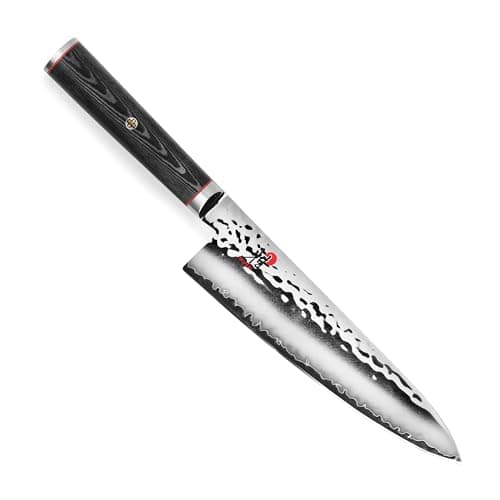
MIYABI
Miyabi Mizu SG2 8" chef's knife, 63 HRC, 12 degrees
See price on Amazon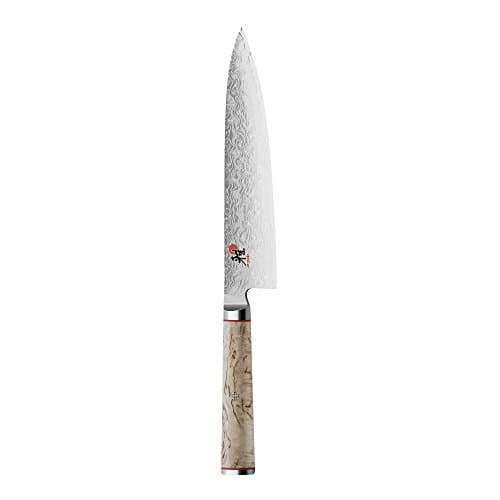
MIYABI
Miyabi Birchwood SG2 8" chef's knife, Karelian birch
See price on Amazon
- Yoshihiro VG10 16-layer 210 mm gyuto, Western handle
- Hardness (HRC)
- 60
- Blade length
- 210 mm (8.25 in)
- Edge angle
- Not stated (double edged)
- Handle
- Mahogany, Western full tang
- Miyabi Mizu SG2 8" chef's knife, 63 HRC, 12 degrees
- Hardness (HRC)
- 63
- Blade length
- 8 in
- Edge angle
- 12 degrees, double bevel
- Handle
- Micarta, D-shaped with bolster
- Miyabi Birchwood SG2 8" chef's knife, Karelian birch
- Hardness (HRC)
- Not stated
- Blade length
- 8 in
- Edge angle
- 9.5-12 degrees
- Handle
- Karelian birch, 5.39 in long
| Pick | Hardness (HRC) | Blade length | Edge angle | Handle | Price | Link |
|---|---|---|---|---|---|---|
| Yoshihiro VG10 16-layer 210 mm gyuto, Western handle | 60 | 210 mm (8.25 in) | Not stated (double edged) | Mahogany, Western full tang | - | Amazon |
| Miyabi Mizu SG2 8" chef's knife, 63 HRC, 12 degrees | 63 | 8 in | 12 degrees, double bevel | Micarta, D-shaped with bolster | - | Amazon |
| Miyabi Birchwood SG2 8" chef's knife, Karelian birch | Not stated | 8 in | 9.5-12 degrees | Karelian birch, 5.39 in long | - | Amazon |
Facts are taken from each Amazon listing. Prices are checked daily and shown with their date.
Verdict
Buy a VG-10 knife such as the Yoshihiro VG10 16 layer gyuto if you want an easy-to-sharpen, forgiving stainless edge at a lower price. Buy an SG2 knife such as the Miyabi Mizu or Birchwood if you want longer edge retention and a thinner edge, and you will avoid bones and twisting cuts.
This page is for cooks comparing two Japanese knives where the main difference on the spec sheet is VG-10 or SG2. Both are stainless, both are common core steels under Damascus cladding, and both make excellent kitchen knives. We compare hardness, edge retention, toughness, sharpening and price, with listing examples such as the Yoshihiro VG10 gyuto and the Miyabi Mizu and Birchwood SG2 chef's knives, and explain where R2 knives such as Takamura gyutos fit in.
What each steel is
VG-10 is made by Takefu Special Steel in Fukui, Japan. It is a high-carbon stainless steel with chromium, molybdenum, vanadium and cobalt, produced by conventional melting. It has been a standard Japanese knife steel for decades. Shun's VG-MAX is a Kai variant of it. Our what is VG-10 steel page has the full composition.
SG2 is a powder metallurgy stainless steel made by Takefu; R2 is the name used by Kobe Steel for essentially the same steel, so SG2 and R2 are treated as the same thing in knife listings. Powder metallurgy produces very fine, evenly spread carbides, which lets the steel run harder while keeping a fine edge. Miyabi uses SG2 in its Mizu, Birchwood and Artisan lines, and makers such as Takamura are known for R2 gyutos.
Side by side
Typical hardness ranges are the manufacturer-stated ranges also used in our steel chart tool. Knife examples use listing facts.
- Edge retention
- rises with hardness
- Chip risk
- rises with hardness
- Ease of sharpening
- falls with hardness
Steels on the chart: X50CrMoV15 HRC 56 to 58; Cromova 18 HRC 56 to 58; AUS-10 HRC 59 to 60; VG-10 HRC 60 to 61; VG-MAX HRC 60 to 61; FC61 HRC 61 to 61; Ginsan (Silver 3) HRC 60 to 61; SG2 / R2 HRC 62 to 64; ZDP-189 HRC 64 to 66; Shirogami 1 and 2 HRC 61 to 64; Aogami 1 and 2 HRC 61 to 64; Aogami Super HRC 63 to 65.
Production
- VG-10
- Conventional melt
- SG2 / R2
- Powder metallurgy
Typical hardness
- VG-10
- HRC 60-61
- SG2 / R2
- HRC 62-64
Stainless
- VG-10
- Yes
- SG2 / R2
- Yes
Edge retention
- VG-10
- Good
- SG2 / R2
- Very good
Chip resistance
- VG-10
- Better
- SG2 / R2
- Lower
Sharpening effort
- VG-10
- Easier
- SG2 / R2
- Slower, benefits from harder stones
Listing example
- VG-10
- Yoshihiro VG10 16 layer gyuto, 210 mm, HRC 60
- SG2 / R2
- Miyabi Mizu SG2 8" chef's, HRC 63, 12 degree edge
Second example
- VG-10
- Shun Classic (VG-MAX variant), 16 degree edge
- SG2 / R2
- Miyabi Birchwood SG2 8", 9.5 to 12 degree edge
| VG-10 | SG2 / R2 | |
|---|---|---|
| Production | Conventional melt | Powder metallurgy |
| Typical hardness | HRC 60-61 | HRC 62-64 |
| Stainless | Yes | Yes |
| Edge retention | Good | Very good |
| Chip resistance | Better | Lower |
| Sharpening effort | Easier | Slower, benefits from harder stones |
| Listing example | Yoshihiro VG10 16 layer gyuto, 210 mm, HRC 60 | Miyabi Mizu SG2 8" chef's, HRC 63, 12 degree edge |
| Second example | Shun Classic (VG-MAX variant), 16 degree edge | Miyabi Birchwood SG2 8", 9.5 to 12 degree edge |
Edge retention and toughness
Hardness and carbide structure decide how long an edge lasts. At HRC 62 to 64 with fine carbides, SG2 resists wear and rolling better than VG-10, so it stays sharp through more meals. It also supports lower edge angles, which is why Miyabi sharpens its SG2 knives to 9.5 to 12 degrees per side.
The trade is toughness. Harder steel is more brittle, so an SG2 edge is more likely to chip if it hits bone, a frozen item or a hard board, or if you twist the blade in a squash. VG-10 at HRC 60 to 61 is more forgiving. Neither steel likes abuse; see chipped Japanese knife for repair and knife gets dull fast for habits that wear any edge.
Sharpening effort
VG-10 sharpens easily on ordinary water stones and forms a manageable burr. SG2 takes longer on the stone because of its hardness and wear resistance, and many sharpeners prefer harder ceramic stones such as the Shapton line for it. A standard 1000 grit stone followed by a finer stone works for both. See whetstone grit guide and how to sharpen a Japanese knife on a whetstone.
Because SG2 holds an edge longer, you sharpen it less often, so the total time can even out. Use the sharpening angle finder to match the factory angle for your brand.
Price difference
SG2 costs more to produce and to grind, so SG2 knives usually cost more than VG-10 knives of the same shape and finish. In our listings, the Yoshihiro VG10 16 layer 210 mm gyuto sits under $200, while Miyabi's SG2 chef's knives run from about $200 for the Mizu to about $300 for the Birchwood 8 inch. Finish, handle material and brand also drive price, so compare like with like. Our how much do Japanese knives cost page breaks down the tiers.
Which steel should you choose
Choose VG-10 (or VG-MAX) if this is your first Japanese knife, the knife will be shared, you want easier sharpening, or you sometimes cut harder foods. It is a proven steel that will outperform most German knives on edge retention. Good options are in best Japanese knives for beginners.
Choose SG2 or R2 if you already use a Japanese knife carefully, sharpen on stones, and want the edge to last longer between sharpenings. See best high-end Japanese knives and best Miyabi knives for SG2 picks, and our Japanese knife steel chart for other steels.
Frequently asked questions
Is SG2 the same as R2? Yes, for knife buyers. SG2 is Takefu's name and R2 is Kobe Steel's name for essentially the same powder stainless steel.
Does SG2 rust? It is stainless and resists rust well, like VG-10. Still hand wash and dry right away.
Is VG-10 good enough for a chef's knife? Yes. VG-10 is one of the most widely used Japanese knife steels and holds a sharp edge well at HRC 60 to 61.
Is a Takamura R2 gyuto in your list? Not currently. Takamura R2 gyutos are well known, but our listed SG2 examples are from Miyabi.
What you need for this
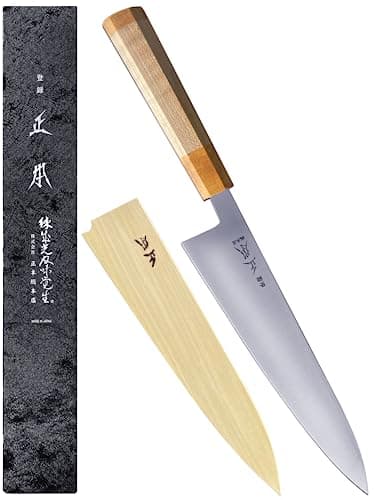 See price on AmazonAmazon
Masamoto KS 240 mm gyuto, Shirogami #2 at HRC 62-63
 See price on AmazonAmazon
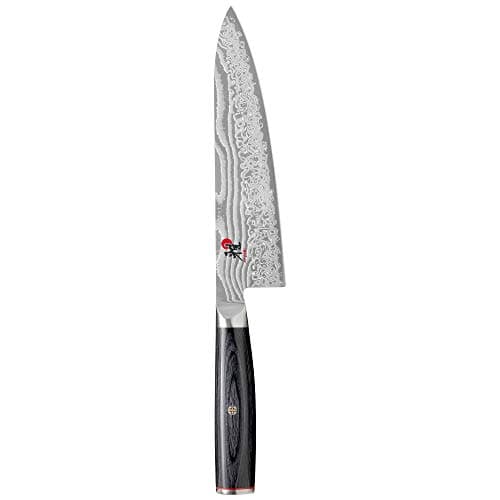
Miyabi Kaizen II 8" chef's knife, FC61 at 61 HRC
From Best Miyabi knives: Kaizen II, Mizu, Koh, Koya, Artisan, Birchwood and Black
 See price on AmazonAmazon
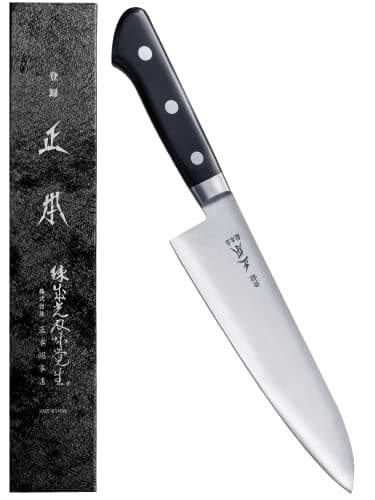
Masamoto VG 240 mm gyuto, HRC 58-59, POM handle
From Best gyuto knives: Japanese chef knives in 210 and 240 mm