Explainer
What HRC means for a kitchen knife
Published
Short answer
HRC is the Rockwell C hardness of a knife's steel. Most German kitchen knives are around HRC 56-58, many Japanese stainless knives are around HRC 60-61, and high-end Japanese knives often reach HRC 62-65. Higher numbers usually mean a sharper, longer-lasting edge, but also more chip risk and slower sharpening.
Picks for this job
All 7 picks compared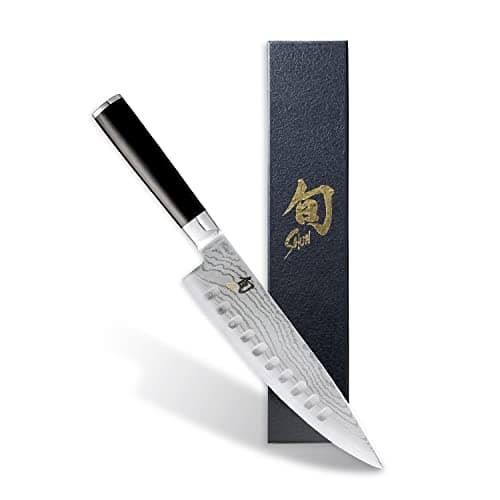
Shun Classic 8 in hollow ground chef, 16-degree
See price on AmazonSee it on Amazon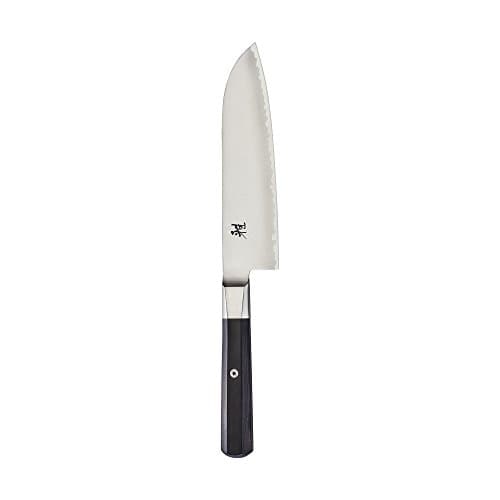
Miyabi Koh 7 in santoku, FC61 at 61 HRC
See price on AmazonSee it on Amazon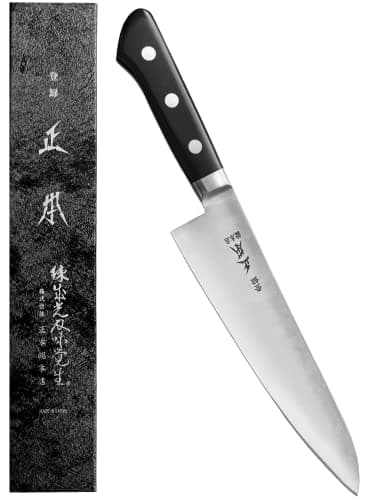
Masamoto AT 210 mm gyuto, 57 HRC, Pakkawood
See price on AmazonSee it on Amazon
Knife listings love to print a number like "HRC 61" or "61 +/- 1 Rockwell". This page explains what that number measures, how it is tested, and what it changes in daily use: how long the edge lasts, how easily it chips, and how hard it is to sharpen. It also gives typical ranges for common Japanese and German steels and helps you decide what hardness suits the way you cook.
What the Rockwell C scale measures
The Rockwell hardness test presses an indenter into a material under a set load and measures how deep it goes. The C scale, written HRC, uses a diamond cone and a heavy load, and it is the standard scale for hardened steels like knife blades. A higher number means the indenter went in less, so the steel is harder.
Hardness comes mostly from the steel's composition and heat treatment. The same steel can end up a couple of points higher or lower depending on how the maker hardens and tempers it. That is why listings often give a range, such as 60-61 or 61 +/- 1.
The scale is not linear in a way that is easy to feel. A one or two point difference is noticeable in how long an edge lasts and how it responds on a stone, while a five or six point gap, such as German HRC 57 vs Japanese HRC 63, changes how the knife should be used and sharpened. Hardness is also only measured on the steel itself. On a clad or Damascus knife, the number refers to the hard core at the edge, not the softer outer layers.
- Edge retention
- rises with hardness
- Chip risk
- rises with hardness
- Ease of sharpening
- falls with hardness
Steels on the chart: X50CrMoV15 HRC 56 to 58; Cromova 18 HRC 56 to 58; AUS-10 HRC 59 to 60; VG-10 HRC 60 to 61; VG-MAX HRC 60 to 61; FC61 HRC 61 to 61; Ginsan (Silver 3) HRC 60 to 61; SG2 / R2 HRC 62 to 64; ZDP-189 HRC 64 to 66; Shirogami 1 and 2 HRC 61 to 64; Aogami 1 and 2 HRC 61 to 64; Aogami Super HRC 63 to 65.
Typical HRC of kitchen knives
These are widely published typical ranges. Check the maker's listing for the exact figure on a given knife. For more detail and care notes, see our Japanese knife steel chart or the steel chart tool.
X50CrMoV15 (Wusthof, Zwilling)
- Typical HRC
- 56-58
- Where you see it
- German chef knives
Cromova 18 (Global)
- Typical HRC
- 56-58
- Where you see it
- Global knives
AUS-10
- Typical HRC
- 59-60
- Where you see it
- Value Japanese knives
VG-10 / VG-MAX
- Typical HRC
- 60-61
- Where you see it
- Many mid-priced Japanese knives, Shun
SG2 / R2
- Typical HRC
- 62-64
- Where you see it
- Higher-end Japanese knives
Shirogami, Aogami
- Typical HRC
- 61-64
- Where you see it
- Carbon steel Japanese knives
Aogami Super
- Typical HRC
- 63-65
- Where you see it
- High-end carbon knives
ZDP-189
- Typical HRC
- 64-66
- Where you see it
- Specialty powder steel knives
| Steel or brand | Typical HRC | Where you see it |
|---|---|---|
| X50CrMoV15 (Wusthof, Zwilling) | 56-58 | German chef knives |
| Cromova 18 (Global) | 56-58 | Global knives |
| AUS-10 | 59-60 | Value Japanese knives |
| VG-10 / VG-MAX | 60-61 | Many mid-priced Japanese knives, Shun |
| SG2 / R2 | 62-64 | Higher-end Japanese knives |
| Shirogami, Aogami | 61-64 | Carbon steel Japanese knives |
| Aogami Super | 63-65 | High-end carbon knives |
| ZDP-189 | 64-66 | Specialty powder steel knives |
What higher hardness gives you
This is the main reason Japanese knives feel so sharp out of the box. See why are Japanese knives so good for the bigger picture.
- Longer edge life. Hard steel resists rolling and wear, so the edge stays sharp through more cutting.
- Thinner, more acute edges. Makers can grind a hard blade thinner and sharpen it at a lower angle, often 10-16 degrees per side on Japanese knives, without it folding over.
- Cleaner cuts. A thin, keen edge glides through food with less wedging and crushing.
What higher hardness costs you
- More chip risk. Hard steel is less tough. Twisting, prying, hitting bone, frozen food or a glass board can chip the edge instead of just rolling it.
- Slower sharpening. Harder steels, especially powder steels with lots of carbides, take longer on a whetstone. Pull-through and coarse electric sharpeners can be rough on them.
- No honing on a steel rod. A grooved steel can damage a hard edge. Use a fine ceramic rod gently or a fine whetstone. See honing rod for Japanese knives.
Note.Softer German knives tend to roll or dent. Harder Japanese knives tend to chip. Neither is a defect; it is how each steel fails under misuse.
What hardness should you buy
For most home cooks, HRC 58-61 is a comfortable range. It gives a clear step up in edge life over a typical German knife while staying forgiving and easy to sharpen. VG-10 and similar stainless steels sit here, and they suit a first Japanese knife.
HRC 62 and up rewards careful technique. If you push and pull cut, avoid bones and frozen food, use a wood board and sharpen on stones, a harder knife will stay sharp much longer. If your kitchen is busy and knives get used roughly, a softer, tougher knife may serve you better. Our Japanese vs German knives page compares the two approaches.
HRC and sharpening
Hard knives are best sharpened on whetstones, which remove little steel and let you hold a low angle. Expect to spend more time on the coarse stone with SG2 or ZDP-189 than with VG-10 or carbon steel. Diamond or high-quality ceramic stones help with very hard powder steels. Our whetstone sharpening guide covers the method, best whetstone sets lists stones, and the sharpening angle finder gives factory angles by brand.
Frequently asked questions
What is a good HRC for a kitchen knife? HRC 58-62 suits most home cooks. Under 58 dulls sooner; above 62 holds an edge very well but needs more careful use.
Is 60 HRC good for a knife? Yes. HRC 60 is typical for good Japanese stainless knives like VG-10 and gives a long-lasting, keen edge with reasonable toughness.
Why do Japanese knives chip? They are hardened to a higher HRC and ground thinner. That edge is less tough, so twisting, bones, frozen food or hard boards can chip it.
Does higher HRC mean a better knife? Not by itself. Heat treatment, geometry, fit and finish and how you use the knife matter as much as the hardness number.
What you need for this
- See price on AmazonAmazon
Shun Classic 8 in hollow ground chef, 16-degree
From Best Japanese knives for beginners: forgiving first picks
 See price on AmazonAmazon
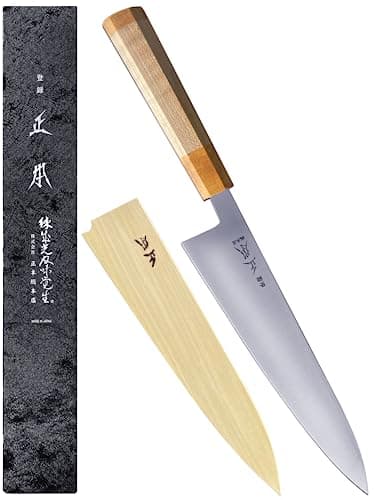
Masamoto KS 240 mm gyuto, Shirogami #2 at HRC 62-63
 See price on AmazonAmazon
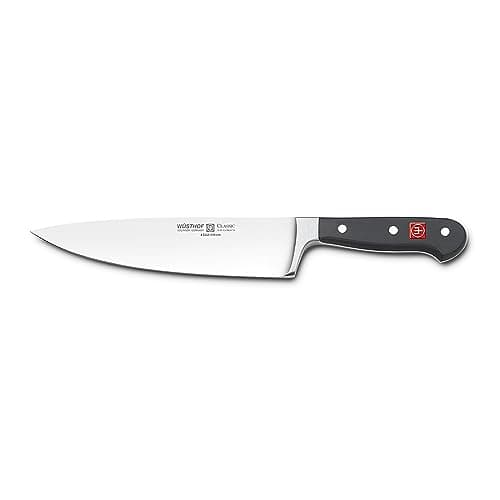
Wusthof Classic 8" chef's knife, forged at 58 HRC
From Best premium German chef knives to compare with a gyuto