Explainer
Why are Japanese knives so sharp
Published
Short answer
Japanese knives are so sharp mainly for three reasons: harder steel (often HRC 60 to 65 versus about 56 to 58 for many German knives), thinner blades behind the edge, and more acute edge angles, often 10 to 16 degrees per side. The trade-offs are a higher chip risk, more careful use and more involved sharpening.
Picks for this job
All 8 picks compared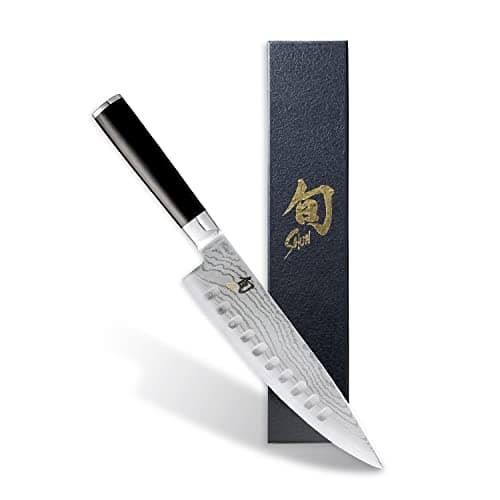
Shun Classic 8" chef's knife, VG-MAX with 16-degree edge
See price on AmazonSee it on Amazon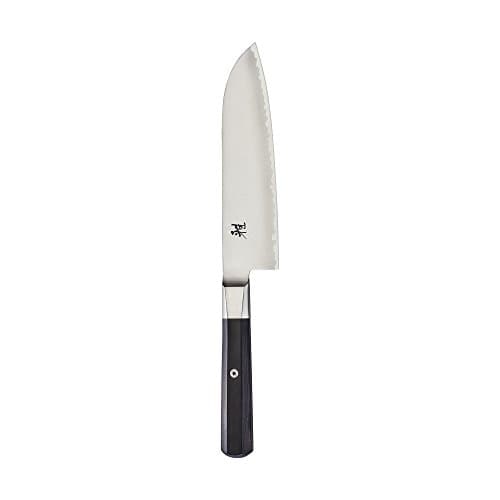
Miyabi Koh 7" santoku, FC61 steel at 61 HRC
See price on AmazonSee it on Amazon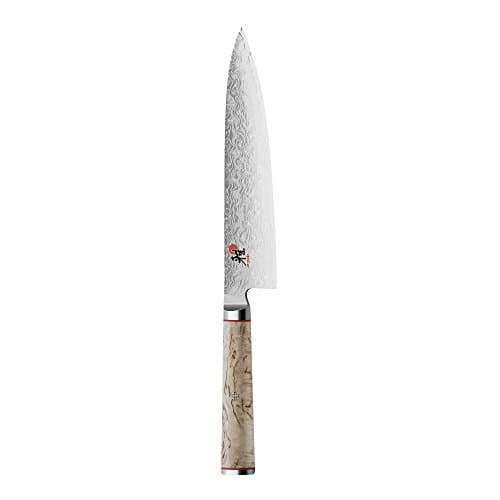
Miyabi Birchwood SG2 8" chef's knife, 9.5-12 degree edge
See price on AmazonSee it on Amazon
People who switch from a German chef knife to a Japanese gyuto usually notice the difference on the first onion. This page explains why, in plain terms: what hardness means, how thin geometry and acute angles reduce cutting effort, how Japanese and German design philosophies differ, and what you give up for that sharpness. It is for home cooks deciding whether a Japanese knife suits how they cook.
Reason 1: harder steel holds a finer edge
Knife steel hardness is measured on the Rockwell C scale (HRC). Many German knives use X50CrMoV15 stainless at about HRC 56 to 58. Popular Japanese steels run higher: VG-10 and VG-MAX at about 60 to 61, SG2 at about 62 to 64, and carbon steels like Aogami and Shirogami at about 61 to 65.
Harder steel can support a thinner, more acute edge without rolling over as quickly. That is why a Japanese knife can be sharpened finer and stay sharp longer in normal use. See what is HRC Rockwell hardness and the steel chart.
- Edge retention
- rises with hardness
- Chip risk
- rises with hardness
- Ease of sharpening
- falls with hardness
Steels on the chart: X50CrMoV15 HRC 56 to 58; Cromova 18 HRC 56 to 58; AUS-10 HRC 59 to 60; VG-10 HRC 60 to 61; VG-MAX HRC 60 to 61; FC61 HRC 61 to 61; Ginsan (Silver 3) HRC 60 to 61; SG2 / R2 HRC 62 to 64; ZDP-189 HRC 64 to 66; Shirogami 1 and 2 HRC 61 to 64; Aogami 1 and 2 HRC 61 to 64; Aogami Super HRC 63 to 65.
Reason 2: thinner blades cut with less force
Sharpness at the very edge is only part of the story. How thick the blade is just behind the edge decides how much the knife wedges food apart as it passes through. Japanese knives are usually ground much thinner, so they slip through dense vegetables like carrots and sweet potatoes instead of cracking them.
Many Japanese knives also skip the full bolster found on classic German knives. That lets you sharpen the entire edge to the heel and keeps the knife lighter.
- Tip
- The point, for fine work
- Belly
- The curve of the edge, for rocking cuts
- Flat
- The straight part of the edge near the heel
- Heel
- The rear corner of the edge
- Choil
- Where the edge ends at the handle
- Spine
- The thick back of the blade
- Ferrule
- The collar of a wa handle; a Western knife has a bolster
- Tang
- The steel inside the handle
- HRC
- Hardness of the steel, here 60-61
Reason 3: more acute edge angles
The edge angle is how steeply each side is sharpened. A lower angle means a thinner wedge at the very edge, which cuts with less resistance. Japanese makers commonly use about 10 to 16 degrees per side. Many traditional German knives were sharpened around 20 degrees per side, though current Wusthof and Zwilling edges are around 14 to 15 degrees.
That last point matters: modern German knives are sharper than they used to be, and the angle gap has narrowed. What remains is that a harder Japanese steel holds a low angle longer before it rolls or dulls. See Japanese knife sharpening angles by brand or the sharpening angle finder.
Miyabi
- Angle per side
- 9.5 to 12 degrees
Global
- Angle per side
- 10 to 15 degrees
Most other double-bevel Japanese knives
- Angle per side
- 12 to 15 degrees
Shun
- Angle per side
- 16 degrees
Wusthof (current edges)
- Angle per side
- 14 degrees
Zwilling and Henckels
- Angle per side
- 15 degrees
| Brand or style | Angle per side |
|---|---|
| Miyabi | 9.5 to 12 degrees |
| Global | 10 to 15 degrees |
| Most other double-bevel Japanese knives | 12 to 15 degrees |
| Shun | 16 degrees |
| Wusthof (current edges) | 14 degrees |
| Zwilling and Henckels | 15 degrees |
Different design philosophies
German knives are built to be tough, versatile and forgiving. Softer steel bends rather than chips, and a heavier blade can power through squash and small bones. A honing steel straightens the edge daily.
Japanese knives are built for precision. Harder steel and thin geometry produce clean cuts that keep food cells intact, which matters for sashimi and fine vegetable work. The knife is guided rather than forced. See Japanese vs German knives for a full comparison.
The trade-offs of a very sharp knife
The same features that make Japanese knives sharp also make them less forgiving.
- Chipping: Hard, thin edges can chip on bones, frozen food, hard rinds or glass boards. See chipped Japanese knife.
- Fragile tips: Thin tips can snap if used to pry.
- Care: Carbon steels rust; all should be hand washed. No dishwasher.
- Sharpening: Harder steels take longer on stones, and pull-through sharpeners can damage them. See electric sharpeners on Japanese knives.
- Technique: They reward straight cuts and punish twisting.
Which is the sharpest chef knife?
There is no single sharpest knife, because sharpness depends on how recently and how well the knife was sharpened. Out of the box, knives with hard steel and acute edges, such as Miyabi's SG2 lines or carbon steel gyuto, are among the keenest. Over months of use, the knife that you keep sharp is the sharpest one in your kitchen.
If you want a Japanese knife that balances sharpness and forgiveness, VG-10 or VG-MAX stainless at about HRC 60 to 61 is a common middle ground. The best Japanese kitchen knives and best gyuto knives guides cover options.
How to keep a Japanese knife that sharp
Sharpness fades with use no matter how good the steel. To keep it:
- 1
Use a wood or soft synthetic board, never glass or stone.
- 2
Cut with push or pull strokes and avoid twisting.
- 3
Hone lightly with a fine ceramic rod or strop rather than a ridged steel.
- 4
Sharpen on whetstones when honing no longer restores the edge.
- 5
Hand wash and dry right away, and store with the edge protected.
Frequently asked questions
Are Japanese knives sharper than German knives? Usually, yes, out of the box and over time, because of harder steel, thinner blades and lower edge angles. Modern German knives have narrowed the angle gap but use softer steel.
Why do Japanese knives chip more? Harder steel is less flexible, so instead of bending it can chip under sideways force or impact.
Does a sharper knife make cooking safer? A sharp knife needs less force and slips less, which makes it safer to control. You still need a good grip and the claw hand.
Are all Japanese knives hard? Most popular ones are HRC 60 or higher, but some, such as Global's Cromova 18 line, run around HRC 56 to 58.
What you need for this
- See price on AmazonAmazon
Shun Classic 8 in hollow ground chef, 16-degree
From Best Japanese kitchen knives for home cooks: one pick per job
 See price on AmazonAmazon
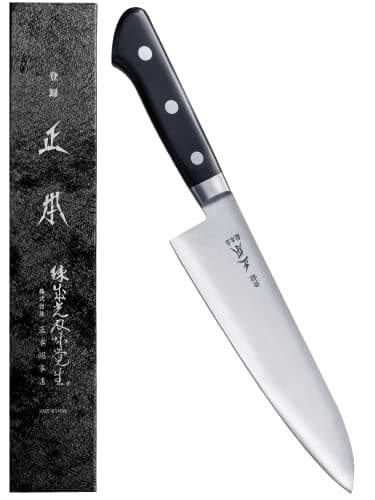
Masamoto VG 240 mm gyuto, HRC 58-59, POM handle
From Best gyuto knives: Japanese chef knives in 210 and 240 mm
 See price on AmazonAmazon
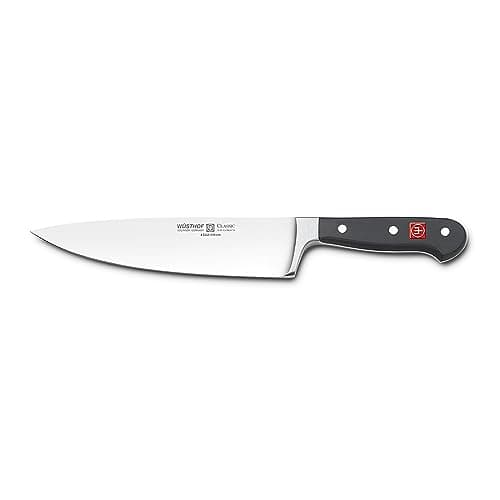
Wusthof Classic 8" chef's knife, forged at 58 HRC
From Best premium German chef knives to compare with a gyuto