Explainer
Can you use an electric sharpener on Japanese knives
Published
Short answer
You can use an electric sharpener on many stainless Japanese knives if it is set to about 15 degrees per side, like the Chef's Choice 15XV, and you use the coarse stage sparingly. They remove more steel than whetstones, cannot match very acute edges like Miyabi's, and are not suitable for single-bevel or very hard, brittle knives.
Picks for this job
All 8 picks compared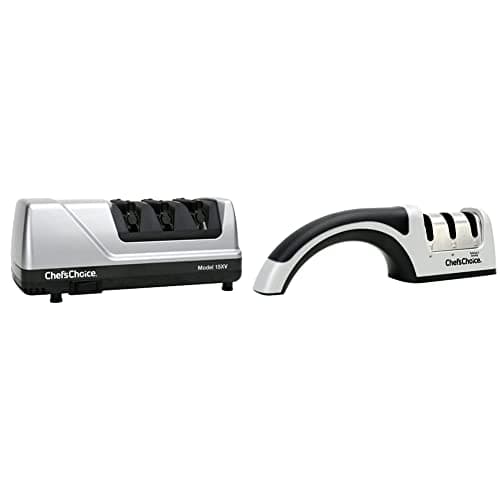
Chef'sChoice Trizor XV, 3-stage electric 15-degree sharpener
See price on AmazonSee it on Amazon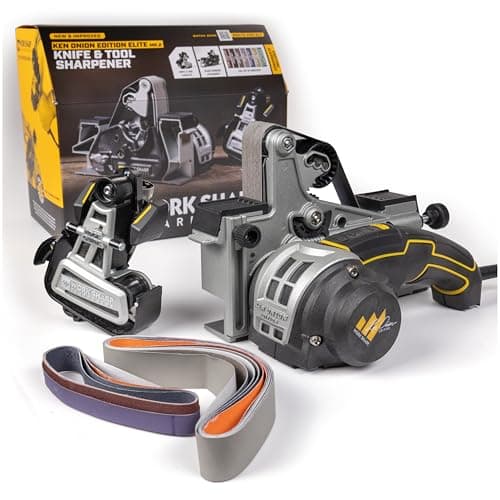
Work Sharp Ken Onion Elite Mk2, belt sharpener 10 to 35 degrees
See price on AmazonSee it on Amazon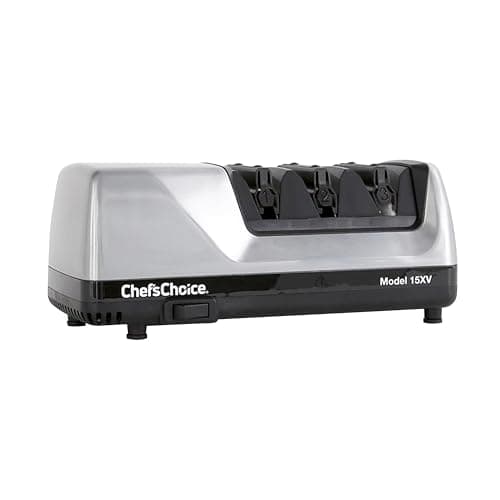
Chef'sChoice 15XV with metal housing, 3-stage diamond
See price on AmazonSee it on Amazon
Electric sharpeners are fast and easy, which makes them tempting for a busy kitchen. Japanese knives, though, have thinner edges, harder steel and lower angles than the German knives most electric sharpeners were first designed for. This page explains how electric sharpeners work, which angles matter, how to use one with less risk, and which knives should only go on stones. It is written for home cooks deciding between an electric unit and whetstones.
How electric sharpeners work
Most electric knife sharpeners have two or three slots, or stages. Each slot holds the blade against spinning abrasive wheels or disks at a fixed angle set by guides. The first stage is coarse and removes metal to form a new edge. Later stages use finer abrasives to refine and polish it. Some final stages strop or hone rather than grind.
Because the angle is fixed by the slot, the sharpener will reshape any knife to its own angle over time. That is the key question for Japanese knives: does the sharpener's angle match your knife, and how aggressively does it remove steel?
Angles: 15 degrees vs 20 degrees
Older and many basic electric sharpeners use about 20 degrees per side, the traditional angle for Western knives. That is too wide for most Japanese knives. Running a Japanese knife through a 20 degree slot gradually turns it into a thicker edge that cuts more like a German knife.
Several electric sharpeners are built for 15 degree edges. The Chef's Choice 15XV is a well-known example; Chef's Choice markets it for converting and maintaining 15 degree edges on both Western and Asian-style knives. Some models have both 15 and 20 degree slots. Check the listing for the stated angle before you buy.
Wusthof (current PEtec)
- Factory angle per side
- 14 degrees
- 15 degree electric fit
- Close match
Zwilling, Henckels
- Factory angle per side
- 15 degrees
- 15 degree electric fit
- Match
Shun double-bevel
- Factory angle per side
- 16 degrees
- 15 degree electric fit
- Close match
Global
- Factory angle per side
- 10-15 degrees
- 15 degree electric fit
- Fair, may widen edge slightly
Most double-bevel Japanese
- Factory angle per side
- 12-15 degrees
- 15 degree electric fit
- Fair to close
Miyabi double-bevel
- Factory angle per side
- 9.5-12 degrees
- 15 degree electric fit
- Poor, edge gets wider
Single-bevel (yanagiba, deba)
- Factory angle per side
- One side only
- 15 degree electric fit
- Not suitable
| Knife | Factory angle per side | 15 degree electric fit |
|---|---|---|
| Wusthof (current PEtec) | 14 degrees | Close match |
| Zwilling, Henckels | 15 degrees | Match |
| Shun double-bevel | 16 degrees | Close match |
| Global | 10-15 degrees | Fair, may widen edge slightly |
| Most double-bevel Japanese | 12-15 degrees | Fair to close |
| Miyabi double-bevel | 9.5-12 degrees | Poor, edge gets wider |
| Single-bevel (yanagiba, deba) | One side only | Not suitable |
Note.Angles are as published by the makers. Use our sharpening angle finder to look up your brand.
The downsides for Japanese knives
Damascus-clad knives sharpen fine on electric units, but scratches on the cladding near the edge are common. See what is HRC for why hard steel behaves differently.
- Steel removal. The coarse stage grinds away more metal than a whetstone, which shortens knife life if used every time.
- Heat. Fast wheels can heat a thin edge. Good units are designed to limit this, but short, light passes are safer.
- Chip risk on very hard steel. Aggressive coarse stages can chip edges on brittle, high-HRC steels like ZDP-189.
- Heel and bolster issues. Some sharpeners cannot reach the heel, which can leave a dip in the edge over time.
- Tips get rounded. Pulling the tip through too fast or lifting the handle rounds the tip.
- No single-bevel support. Electric sharpeners sharpen both sides and will ruin a single-bevel grind.
How to use an electric sharpener on a Japanese knife
- 1
Confirm the sharpener's angle is about 15 degrees per side and that the maker lists Asian-style knives as compatible.
- 2
Skip the coarse stage unless the knife is truly dull or has small chips. Start on the finest stage for routine touch-ups.
- 3
Pull the knife through slowly and evenly from heel to tip, with no downward pressure. Let the guides hold the angle.
- 4
Alternate sides with the same number of passes so the edge stays centered.
- 5
As you reach the tip, keep the blade level so the tip does not get rounded.
- 6
Wipe the blade clean to remove metal dust, then test on paper or a tomato.
Note.Always read the manual for your model. Pass counts and stage use vary between sharpeners.
When to use whetstones instead
Use whetstones for single-bevel knives, very acute edges like Miyabi, very hard powder steels, high-end knives you want to keep for decades, and carbon steel knives you want to sharpen to a very fine finish. Stones remove the least metal, let you choose the angle, and give the cleanest edge. Our whetstone sharpening guide walks through the process.
A reasonable middle ground for many home cooks: whetstones or a professional service for a full sharpening once or twice a year, and an electric unit on its fine stage, or a fine ceramic rod, for quick touch-ups. Shun owners can also use Kai's mail-in service; see Shun free sharpening.
Pull-through vs electric vs guided systems
Manual pull-through sharpeners work on the same fixed-angle idea without a motor, usually with carbide or ceramic. Carbide slots can be rough on hard edges. Guided systems clamp the knife or rest it on an angle guide while you move a stone over the edge; they are slower but let you set the exact angle. If you want convenience without giving up control, a guided system is a strong option. See best sharpeners for Japanese knives and best whetstone sets.
Frequently asked questions
Will an electric sharpener ruin my Japanese knife? Not if it is a 15 degree unit used gently on a double-bevel stainless knife. It will remove more steel than stones and can widen very acute edges.
Is the Chef's Choice 15XV good for Japanese knives? It is designed for 15 degree edges, which suits many double-bevel Japanese knives. It is not suitable for single-bevel knives, and it will widen Miyabi's more acute edge.
Can I use an electric sharpener on Shun knives? Shun's edge is 16 degrees, close to a 15 degree sharpener. Shun also offers free mail-in sharpening, which keeps the factory angle.
How often should I use an electric sharpener? Only when the knife is dull. Use the fine stage for touch-ups and the coarse stage rarely.
What you need for this
- See price on AmazonAmazon
Chef'sChoice Trizor XV, 3-stage electric 15-degree sharpener
 See price on AmazonAmazon
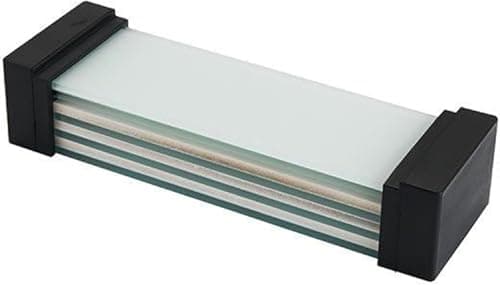
Shapton Glass 500, 2000, 16000 set with Field Holder
 See price on AmazonAmazon
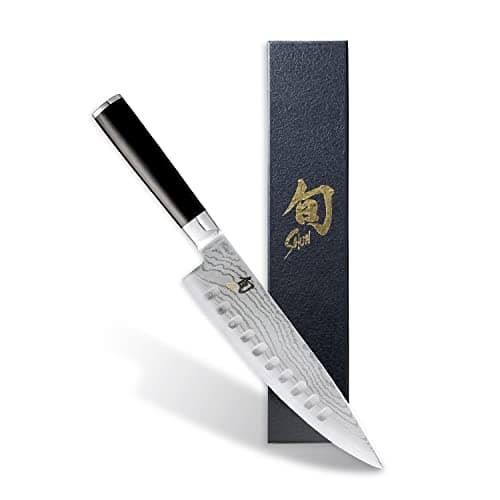
Shun Classic 8 in hollow ground chef, 16-degree
From Best Shun knives: Classic, Premier, Dual Core, Sora and Kanso