Gear guide
Best knife sharpeners for Japanese knives
Updated Picked from Amazon listings, not hands-on tests. How we pick
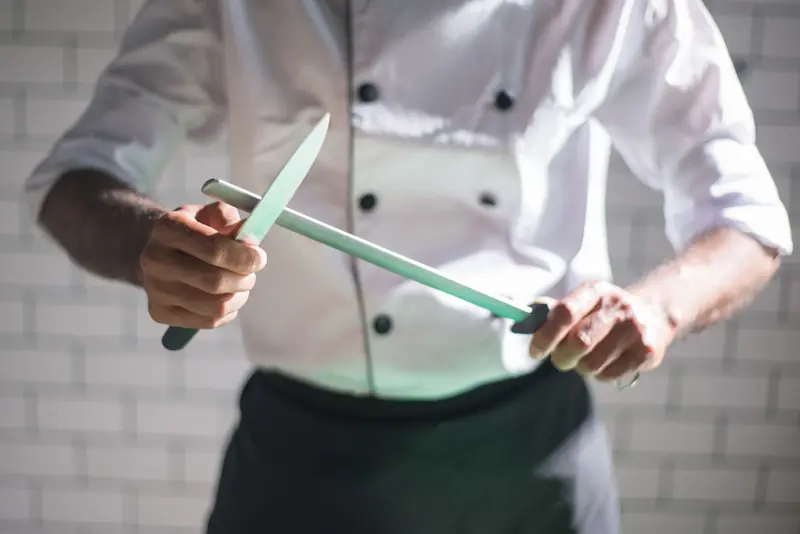
Japanese knives are usually ground thinner than German ones, often between about 9.5 and 16 degrees per side, and many use hard steel around 60 HRC or above. A sharpener built only for a 20-degree edge will slowly turn that fine edge into a thicker one, which throws away much of what you paid for. So the first question is simple: can it hold an angle of 15 degrees or less? After that, look at the abrasive (diamond cuts hard steel well, ceramic and stropping stages refine the edge), how many stages it has, and whether you also need it for serrated bread knives. This guide compares eight guided and powered sharpeners from Chef'sChoice, Work Sharp, Tormek and HORL on angle, abrasive, stages and serrated support, using only what each Amazon listing states. If you prefer stones, see our whetstone guide.
As an Amazon Associate we earn from qualifying purchases. This does not change our picks. Affiliate disclosure
New to Prime? Try Prime free for fast, free shipping on eligible items.
Top picks at a glance
Compare all picksClosest match for the job
Chef'sChoice 15 Trizor XV EdgeSelect Sharpener
The listing states it converts 20-degree factory edges into 15-degree Trizor XV edges.
See price on AmazonSee it on AmazonMost for the money on paper
Work Sharp Ken Onion Elite Mk2 Knife Sharpener
The listing states a fully adjustable angle from 10 to 35 degrees.
See price on AmazonSee it on AmazonMost complete listing
Tormek T-1, diamond wheel and honing wheel, 45 dB
The listing states minimal material removal, so less steel is ground away per sharpening.
See price on AmazonSee it on Amazon
Compare the picks
- Chef'sChoice 15 Trizor XV EdgeSelect Sharpener
- Type
- Electric, 3-stage
- Angle
- 15 degrees (converts 20-degree edges)
- Abrasive
- 100 percent diamond, polishing stage
- Serrated knives
- Yes
- Work Sharp Ken Onion Elite Mk2 Knife Sharpener
- Type
- Electric belt, variable speed
- Angle
- Adjustable 10-35 degrees
- Abrasive
- Flexible abrasive belts
- Serrated knives
- Yes
- Tormek T-1, diamond wheel and honing wheel, 45 dB
- Type
- Powered diamond wheel with angle guide
- Angle
- Not stated (adjustable guide)
- Abrasive
- Fine diamond wheel, composite honing wheel
- Serrated knives
- Not stated
- HORL 3 Walnut rolling sharpener, 15 and 20 degrees
- Type
- Manual rolling, magnetic angle holder
- Angle
- 15 and 20 degrees
- Abrasive
- Diamond disc, ceramic honing disc
- Serrated knives
- Not stated
- Chef'sChoice AngleSelect Knife Sharpener, 2-Stage
- Type
- Electric, 2-stage
- Angle
- 15 or 20 degrees (selectable)
- Abrasive
- Diamond, stropping disks
- Serrated knives
- Yes
Facts are taken from each Amazon listing. Prices are checked daily and shown with their date.
The picks in detail
Pick 1 · Chef’sChoice
Chef'sChoice 15 Trizor XV EdgeSelect Sharpener
See price on AmazonA 3-stage electric sharpener built to put a 15-degree edge on knives, with diamond abrasives in all stages. The simplest way to keep Japanese-style edges sharp without learning stones.
What the listing offers
- The listing states it converts 20-degree factory edges into 15-degree Trizor XV edges.
- Spring guides are described as automatically controlling the sharpening angle.
- Handles straight and serrated blades, with 100 percent diamond abrasives in all three stages.
Limits to know
- The product page gives noise between 65 and 75 dB, louder than the 45 dB Tormek.
- A fixed 15-degree angle cannot match a knife ground finer, such as 9.5 to 12 degrees.
Pick 2 · WORK SHARP
Work Sharp Ken Onion Elite Mk2 Knife Sharpener
See price on AmazonA motorized belt sharpener with an angle guide that adjusts from 10 to 35 degrees. The widest angle range here, so it can match very fine Japanese edges as well as tougher knives.
What the listing offers
- The listing states a fully adjustable angle from 10 to 35 degrees.
- Variable motor speed is listed for anything from heavy repair to a light finish.
- Flexible belt is described as able to reprofile chipped or rolled edges.
Limits to know
- A belt leaves a convex edge, per the spec sheet, rather than the flat bevel some Japanese knives ship with.
- Powerful belts can remove steel fast on hard, thin blades, so slow speeds matter.
Pick 3 · Tormek
Tormek T-1, diamond wheel and honing wheel, 45 dB
See price on AmazonA heavy, quiet kitchen sharpener with a fine diamond wheel and a composite honing wheel. For buyers who want minimal steel removal on expensive knives and a machine built to last.
What the listing offers
- The listing states minimal material removal, so less steel is ground away per sharpening.
- Patented guide is described as setting the sharpening angle precisely.
- Powder-coated cast zinc housing and quiet 45 dB operation are listed.
Limits to know
- The manufacturer does not state the angle range, so confirm it covers your knives' edge.
- Highest price in this guide, and serrated knife support is not stated.
Pick 4 · HORL
HORL 3 Walnut rolling sharpener, 15 and 20 degrees
See price on AmazonHORL's newer rolling sharpener with block diamonds that the listing says remove up to 80 percent more steel than HORL2. A cheaper route to a guided 15-degree edge.
What the listing offers
- The spec sheet states up to 80 percent more steel removal than the HORL2 standard disc.
- A Grip Pad with up to 70 percent more hold than HORL2 is listed.
- 15-degree angle is described for fine carbon or Damascus blades.
Limits to know
- More aggressive removal is less ideal for frequent touch-ups on thin Japanese edges.
- Serrated knife support is not stated in the spec sheet.
Pick 5 · Chef's Choice
Chef'sChoice AngleSelect Knife Sharpener, 2-Stage
See price on AmazonAn electric sharpener that lets you choose a 15-degree edge for Japanese knives or 20 degrees for tougher Western ones. Suits a mixed knife block.
What the listing offers
- The listing states a choice of a traditional 20-degree or a finer 15-degree edge.
- Diamond abrasives and patented stropping disks are both listed.
- Precision angle guides are described as removing guesswork.
Limits to know
- Two stages, one fewer than the 15XV and Trizor XV models.
- The product page does not state noise level or sharpening time.
Read before you buy
- Zwilling Pro vs Wusthof ClassicZwilling Pro vs Wusthof Classic 8-inch chef knives: curved vs full bolster, profile, steel and hardness, handle and care, and which German flagship to buy.
- Whetstone grit guide: which grits you needCoarse, medium and fine whetstone grits explained by job. Most home cooks need a 1000 grit stone, plus a 3000-6000 finisher and a coarse stone for repairs.
- Shun free sharpening and repair: how the service worksHow Shun's free lifetime sharpening and warranty service works as of October 2026: the fee, what Kai repairs, how to ship knives and where to drop them off.
- Why your knife gets dull so fast and how to stop itWhy a knife dulls quickly: hard cutting boards, scraping with the edge, twisting, over-honing and leftover burrs. Fix each cause and keep your edge longer.
- Japanese knife sharpening angles by brandFactory edge angles per side as makers publish them: Shun 16, Miyabi 9.5-12, Global 10-15, MAC 15, Wusthof 14, Zwilling 15, plus a coin trick to hold the angle.
More gear: Sharpening and edges
Edge & Haft chooses every product independently from what its Amazon listing states. We may earn a commission from the links above. As an Amazon Associate I earn from qualifying purchases.