Comparison
Zwilling Pro vs Wusthof Classic
Published
Short answer
Both are forged, full-tang, triple-riveted German chef knives in high-carbon stainless steel. The Zwilling Pro has a curved, half bolster that supports a pinch grip and leaves the whole edge free to sharpen. The Wusthof Classic has a full bolster and finger guard, weighs a listed 8.5 ounces and is tempered to 58 HRC. Pick the Zwilling Pro for a pinch grip and easy full-length sharpening; pick the Wusthof Classic for a heavier, more guarded traditional feel.
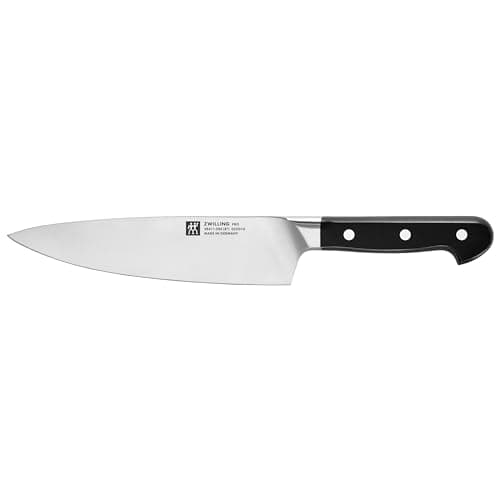
ZWILLING
Zwilling Pro 8" chef's knife with curved bolster
See price on Amazon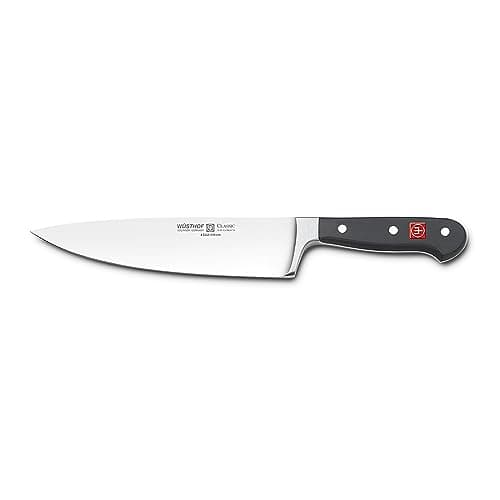
Wüsthof
Wusthof Classic 8" chef's knife, forged at 58 HRC
See price on Amazon
- Zwilling Pro 8" chef's knife with curved bolster
- Steel
- Special formula high-carbon stainless, ice-hardened
- Hardness (HRC)
- Not stated
- Blade length
- 8 in
- Edge angle
- Not stated
- Wusthof Classic 8" chef's knife, forged at 58 HRC
- Steel
- High carbon stainless, forged
- Hardness (HRC)
- 58
- Blade length
- 8 in
- Edge angle
- Not stated
| Pick | Steel | Hardness (HRC) | Blade length | Edge angle | Price | Link |
|---|---|---|---|---|---|---|
| Zwilling Pro 8" chef's knife with curved bolster | Special formula high-carbon stainless, ice-hardened | Not stated | 8 in | Not stated | - | Amazon |
| Wusthof Classic 8" chef's knife, forged at 58 HRC | High carbon stainless, forged | 58 | 8 in | Not stated | - | Amazon |
Facts are taken from each Amazon listing. Prices are checked daily and shown with their date.
Verdict
Buy the Zwilling Pro 8-inch if you use a pinch grip and want full-length sharpening thanks to its curved bolster. Buy the Wusthof Classic 8-inch if you prefer a heavier knife with a full bolster and finger guard and a stated 58 HRC blade.
This page is for cooks who want a German chef knife and have narrowed it to the two best-known flagships: the Zwilling Pro and the Wusthof Classic, both 8 inches. They look similar from a distance, but the bolster design, blade profile and handle shape make them feel different in the hand. This comparison covers those details, the steel and edge, care and sharpening, and how each suits different grips and kitchens. If you are still deciding between German and Japanese, start with our Japanese vs German overview.
Zwilling Pro vs Wusthof Classic at a glance
Both knives are made in Germany, forged from a single piece of high-carbon stainless steel, with a full tang and a triple-riveted synthetic handle. Both are workhorses that handle everything from onions to splitting a chicken, and both respond well to a honing steel between sharpenings. The differences come down to ergonomics more than performance.
The Zwilling Pro's signature is its curved bolster, which slopes down from the spine toward the edge instead of running all the way to it. The Wusthof Classic keeps a traditional full bolster with a finger guard that extends to the heel of the edge. That one detail affects grip, safety and sharpening, as the sections below explain. For the bigger picture, see Japanese vs German knives.
Spec table: 8-inch chef knives
Specs come only from the listings. Where a listing does not state a figure, the table says so rather than guessing.
Steel
- Zwilling Pro 8" Chef
- Special formula high-carbon stainless
- Wusthof Classic 8" Chef
- High carbon stainless
Forging
- Zwilling Pro 8" Chef
- SIGMAFORGE, single piece
- Wusthof Classic 8" Chef
- Precision forged, single block
Hardness
- Zwilling Pro 8" Chef
- Not stated in listing
- Wusthof Classic 8" Chef
- 58 HRC
Heat treatment
- Zwilling Pro 8" Chef
- Ice-hardened FRIODUR
- Wusthof Classic 8" Chef
- Not stated in listing
Edge
- Zwilling Pro 8" Chef
- Precision-honed, laser-controlled
- Wusthof Classic 8" Chef
- PEtec (Precision Edge Technology)
Bolster
- Zwilling Pro 8" Chef
- Curved bolster
- Wusthof Classic 8" Chef
- Full bolster and finger guard
Handle
- Zwilling Pro 8" Chef
- Full tang, triple riveted
- Wusthof Classic 8" Chef
- Full tang, triple riveted, synthetic, 4.5" long
Weight
- Zwilling Pro 8" Chef
- Not stated in listing
- Wusthof Classic 8" Chef
- 8.5 oz
Made in
- Zwilling Pro 8" Chef
- Germany, company-owned factory
- Wusthof Classic 8" Chef
- Solingen, Germany
| Spec | Zwilling Pro 8" Chef | Wusthof Classic 8" Chef |
|---|---|---|
| Steel | Special formula high-carbon stainless | High carbon stainless |
| Forging | SIGMAFORGE, single piece | Precision forged, single block |
| Hardness | Not stated in listing | 58 HRC |
| Heat treatment | Ice-hardened FRIODUR | Not stated in listing |
| Edge | Precision-honed, laser-controlled | PEtec (Precision Edge Technology) |
| Bolster | Curved bolster | Full bolster and finger guard |
| Handle | Full tang, triple riveted | Full tang, triple riveted, synthetic, 4.5" long |
| Weight | Not stated in listing | 8.5 oz |
| Made in | Germany, company-owned factory | Solingen, Germany |
Curved bolster vs full bolster
The Zwilling Pro listing describes its curved bolster as a natural extension of the hand. In practice the sloped bolster gives your thumb and forefinger a comfortable place to pinch the blade, which is the grip most chefs teach for control. Because the bolster stops short of the edge, you can sharpen the full length of the blade right to the heel, and the heel stays usable for tough cuts.
The Wusthof Classic's full bolster and finger guard add weight at the balance point and put a solid barrier between your fingers and the edge. Many home cooks like that sense of security, especially with a hammer grip. The downside is that over years of sharpening, the edge wears back while the bolster does not, so the heel can start to lift off the board unless the bolster is ground down. See how to hold a chef knife to work out which grip you use.
- Tip
- The point, for fine work
- Belly
- The curve of the edge, for rocking cuts
- Flat
- The straight part of the edge near the heel
- Heel
- The rear corner of the edge
- Choil
- Where the edge ends at the handle
- Spine
- The thick back of the blade
- Ferrule
- The collar of a wa handle; a Western knife has a bolster
- Tang
- The steel inside the handle
- HRC
- Hardness of the steel, here 60-61
Profile, hardness and edge
Both are classic German chef knife profiles with a curved belly that rocks well. Wusthof states 58 HRC for the Classic; Zwilling does not state hardness in the Pro listing but describes an ice-hardened FRIODUR blade. German steels of this type are commonly run in the mid to high 50s HRC, softer than most Japanese steels, which our steel chart tool lays out. Softer steel is tougher and easier to hone, but it needs touching up more often.
Edge angles are close. Wusthof's current PEtec edges and Zwilling's edges are commonly published at about 14 and 15 degrees per side respectively; the sharpening angle finder lists brand angles. Either knife works with most electric and pull-through sharpeners set to 15 degrees, as well as whetstones. Our sharpener guide covers models that handle both German and Japanese angles.
- Edge retention
- rises with hardness
- Chip risk
- rises with hardness
- Ease of sharpening
- falls with hardness
Steels on the chart: X50CrMoV15 HRC 56 to 58; Cromova 18 HRC 56 to 58; AUS-10 HRC 59 to 60; VG-10 HRC 60 to 61; VG-MAX HRC 60 to 61; FC61 HRC 61 to 61; Ginsan (Silver 3) HRC 60 to 61; SG2 / R2 HRC 62 to 64; ZDP-189 HRC 64 to 66; Shirogami 1 and 2 HRC 61 to 64; Aogami 1 and 2 HRC 61 to 64; Aogami Super HRC 63 to 65.
Care, dishwashers and long-term ownership
The Zwilling Pro's listing title calls it dishwasher safe. Even so, hand washing is the better habit for any good knife: dishwasher heat, detergent and contact with other items dull edges and can wear handles over time. The Wusthof Classic's synthetic handle is described as resisting fading and discoloration, and the same hand-wash advice applies.
Both knives are built to last for many years. Hone a few strokes before or after each session, sharpen when honing stops helping, and store them in a block or on a magnetic strip. Our dishwasher page and storage guide apply to German knives too.
- Hone often with a steel or ceramic rod.
- Hand wash and dry right after use.
- Use a wood or rubber board, not glass or stone.
- Sharpen at about 14 to 15 degrees per side.
Which German flagship to buy
Buy the Zwilling Pro if you use or want to learn a pinch grip, want to sharpen the full edge without a bolster in the way, or like a slightly more modern handle feel. It suits cooks who do a lot of rocking and fast board work.
Buy the Wusthof Classic if you like a heavier, planted knife with a full finger guard, prefer the traditional look, or want the stated 58 HRC hardness and 8.5 ounce weight as known quantities. Both lines are sold as sets too: compare our Zwilling knife sets and Wusthof knife sets guides if you want a full block.
Frequently asked questions
Is Zwilling or Wusthof better? Neither is better across the board. Both make durable forged German knives. The Zwilling Pro favors a pinch grip with its curved bolster; the Wusthof Classic offers a full bolster and finger guard. Choose on grip and feel.
Which is heavier? The Wusthof Classic 8-inch lists 8.5 ounces. The Zwilling Pro listing does not state a weight, but the full bolster on the Wusthof generally adds weight near the handle.
Can I sharpen these on a whetstone? Yes. Both sharpen well on whetstones at about 14 to 15 degrees per side. See our whetstone guide; the steps are the same for German knives.
How do they compare with Japanese knives? Japanese chef knives are usually lighter, thinner and harder, with more acute edges. See Shun vs Wusthof for a direct comparison.
What you need for this
- See price on AmazonAmazon
Wusthof Classic 8" chef's knife, forged at 58 HRC
From Best premium German chef knives to compare with a gyuto
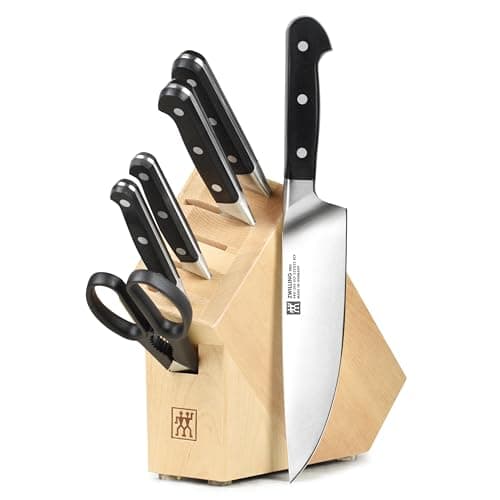 See price on AmazonAmazon
Zwilling Pro 7-piece Studio set, 57 HRC, 15 degrees
From Best Zwilling knife sets: Pro, Four Star, Kramer and more
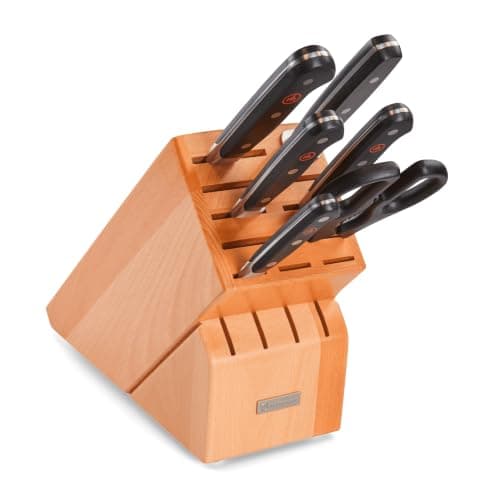 See price on AmazonAmazon
Wusthof Classic 7-piece block set, 58 HRC
From Best Wusthof knife sets: Classic, Classic Ikon and Gourmet
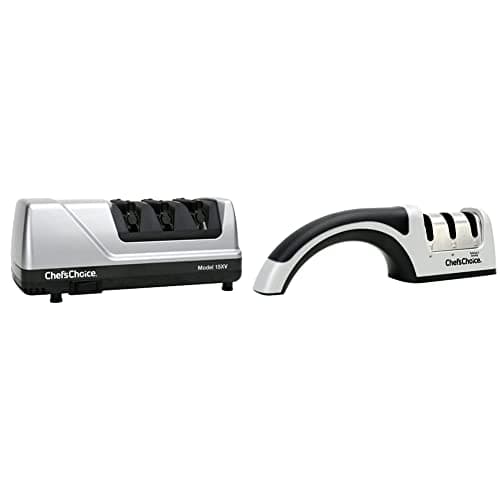 See price on AmazonAmazon
Chef'sChoice Trizor XV, 3-stage electric 15-degree sharpener