Explainer
Japanese knife sharpening angles by brand
Published
Short answer
As the makers publish them, factory edge angles per side are: Shun 16 degrees, Miyabi 9.5 to 12 degrees, Global 10 to 15 degrees, MAC about 15 degrees, Wusthof 14 degrees on its current PEtec edges and Zwilling 15 degrees. For other double-bevel Japanese knives with no published angle, a typical range is about 12 to 15 degrees per side. Match the factory angle when you sharpen, or go slightly steeper for a sturdier edge.
Picks for this job
All 6 picks compared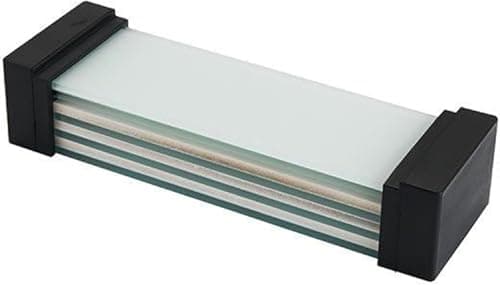
Shapton Glass 500, 2000, 16000 set with Field Holder
See price on AmazonSee it on Amazon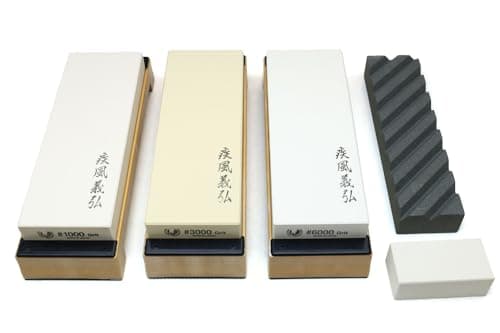
Yoshihiro 1000, 3000, 6000 set with fixer and nagura
See price on AmazonSee it on Amazon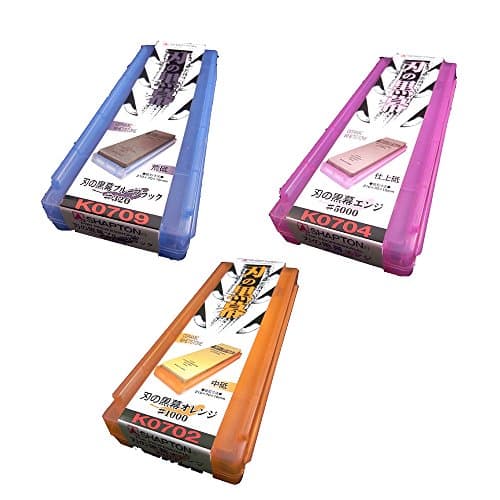
Shapton Kuromaku D-set: 320, 1000, 5000
See price on AmazonSee it on Amazon
This page is for home cooks sharpening a Shun, Miyabi, Global, MAC or German knife who want the right angle instead of a guess. It lists the edge angles the makers publish, explains the difference between per-side and inclusive angles, gives a typical range where no figure is published, and shows a simple coin-height trick for holding the angle on a whetstone. Angles for santokus and other shapes follow the same brand figures.
Per side vs inclusive angle
Edge angles are quoted two ways. The angle per side is the angle between one bevel and the center line of the blade; it is the angle you hold on the stone. The inclusive angle is both sides added together. A knife sharpened at 15 degrees per side has a 30 degree inclusive edge. All figures on this page are per side unless stated otherwise.
Lower angles give a thinner, keener edge that cuts with less effort but is more fragile. Higher angles are sturdier but feel less sharp. Hard Japanese steels can support lower angles than softer German steels, which is why Japanese brands publish smaller numbers.
Factory edge angles by brand
The table lists the angles each maker publishes for its standard double-bevel knives. Specific series can differ, and makers update their specifications, so check the current care or sharpening page for your exact knife. Single-bevel knives such as yanagiba and deba are sharpened differently and are not covered here.
Shun (Kai)
- Angle per side
- 16 degrees
- Inclusive
- 32 degrees
- Notes
- Applies across Shun's double-bevel lines
Miyabi
- Angle per side
- 9.5-12 degrees
- Inclusive
- 19-24 degrees
- Notes
- Hand-honed Honbazuke edge
Global
- Angle per side
- 10-15 degrees
- Inclusive
- 20-30 degrees
- Notes
- Global's own sharpeners and guides are set to 15 degrees
MAC
- Angle per side
- About 15 degrees
- Inclusive
- About 30 degrees
- Notes
- MAC's Rollsharp sharpener is designed around this angle
Wusthof
- Angle per side
- 14 degrees
- Inclusive
- 28 degrees
- Notes
- Current PEtec edges on Western knives
Zwilling J.A. Henckels
- Angle per side
- 15 degrees
- Inclusive
- 30 degrees
- Notes
- German-made Zwilling lines
Other Japanese double-bevel
- Angle per side
- Typically 12-15 degrees
- Inclusive
- 24-30 degrees
- Notes
- Typical range, not a published figure
| Brand | Angle per side | Inclusive | Notes |
|---|---|---|---|
| Shun (Kai) | 16 degrees | 32 degrees | Applies across Shun's double-bevel lines |
| Miyabi | 9.5-12 degrees | 19-24 degrees | Hand-honed Honbazuke edge |
| Global | 10-15 degrees | 20-30 degrees | Global's own sharpeners and guides are set to 15 degrees |
| MAC | About 15 degrees | About 30 degrees | MAC's Rollsharp sharpener is designed around this angle |
| Wusthof | 14 degrees | 28 degrees | Current PEtec edges on Western knives |
| Zwilling J.A. Henckels | 15 degrees | 30 degrees | German-made Zwilling lines |
| Other Japanese double-bevel | Typically 12-15 degrees | 24-30 degrees | Typical range, not a published figure |
Note.The last row is a typical range, not a maker's specification. If your brand does not publish an angle, start at 15 degrees per side and adjust from there.
What about santokus and other shapes
Within a brand, the published angle usually applies to all its double-bevel shapes: gyuto, santoku, nakiri, petty and slicer alike. A Shun santoku is sharpened at 16 degrees just like a Shun chef knife. Some German makers sell Asian-style santokus and nakiris with a more acute edge than their Western shapes, so check the listing for those.
If you are not sure what edge a used or unbranded knife has, color the bevel with a marker, make one light pass on the stone, and look where the ink came off. If it is removed only at the shoulder, lower the spine; if only at the very edge, raise it.
The coin-height trick for holding the angle
Holding an angle by feel is the hardest part of whetstone sharpening. A simple aid is to work out how high the spine should sit above the stone. The height equals the blade height multiplied by the sine of the angle. For a blade about 45 mm tall at the heel, which is common for a 210 mm gyuto or a santoku, the table below gives the spine lift and the equivalent stack of US pennies (1.52 mm thick each).
Stack the coins under the spine to see the angle, then hold that position as you sharpen. The figure is an approximation because blade height changes toward the tip, so lift the handle slightly as you move toward the point. The sharpening angle finder calculates this for any blade height and angle.
10 degrees
- Spine lift
- 7.8 mm
- About how many pennies
- 5
12 degrees
- Spine lift
- 9.4 mm
- About how many pennies
- 6
14 degrees
- Spine lift
- 10.9 mm
- About how many pennies
- 7
15 degrees
- Spine lift
- 11.6 mm
- About how many pennies
- 7 to 8
16 degrees
- Spine lift
- 12.4 mm
- About how many pennies
- 8
| Angle per side | Spine lift | About how many pennies |
|---|---|---|
| 10 degrees | 7.8 mm | 5 |
| 12 degrees | 9.4 mm | 6 |
| 14 degrees | 10.9 mm | 7 |
| 15 degrees | 11.6 mm | 7 to 8 |
| 16 degrees | 12.4 mm | 8 |
Should you change the factory angle
Most home cooks should stay close to the factory angle. It suits the steel's hardness and the blade's thickness, and matching it means less metal is removed. Going one or two degrees steeper (a higher number) adds durability if you see small chips, while going lower makes the knife feel sharper but more delicate.
Do not take a hard Japanese knife much below its factory angle unless you cut only soft food on a soft board. Equally, do not sharpen a Japanese knife at 20 degrees in a pull-through sharpener designed for German knives; it removes a lot of steel and thickens the edge. See electric sharpeners on Japanese knives for when they are and are not suitable.
- Chipping often: raise the angle by 1 to 2 degrees and check your cutting board.
- Edge rolls or dulls fast: check technique and board first; see knife gets dull fast.
- Want a keener edge on a hard steel: lower by 1 to 2 degrees and refine on a fine stone.
Sharpening at the right angle step by step
For the full process, see how to sharpen a Japanese knife on a whetstone, and for brand-specific tips, how to sharpen Shun knives and how to sharpen Miyabi knives. The whetstone set guide covers the stones to use.
- 1
Soak or splash the whetstone as the maker directs, and set it on a damp towel or holder.
- 2
Set the angle using the coin stack or an angle guide, then remove the coins.
- 3
Sharpen one side from heel to tip until you can feel a small burr along the opposite edge.
- 4
Repeat on the other side at the same angle.
- 5
Move to a finer grit and repeat with lighter pressure.
- 6
Remove the burr with a few very light alternating strokes.
Frequently asked questions
What angle should I sharpen a Shun knife? Shun publishes 16 degrees per side for its double-bevel knives.
What angle is a Miyabi knife? Miyabi lists 9.5 to 12 degrees per side. Sharpening at the top of that range, about 12 degrees, gives a little more durability.
Is 15 or 20 degrees better for Japanese knives? For most Japanese knives, about 12 to 16 degrees per side, close to the factory angle, is the better choice. 20 degrees per side is a common setting for softer Western knives and is unnecessarily thick for hard Japanese steel.
Do I need an angle guide? No, but a clip-on guide or the coin trick helps beginners hold a consistent angle until it becomes muscle memory. Consistency matters more than the exact number.
What you need for this
- See price on AmazonAmazon
Shapton Glass 500, 2000, 16000 set with Field Holder
 See price on AmazonAmazon
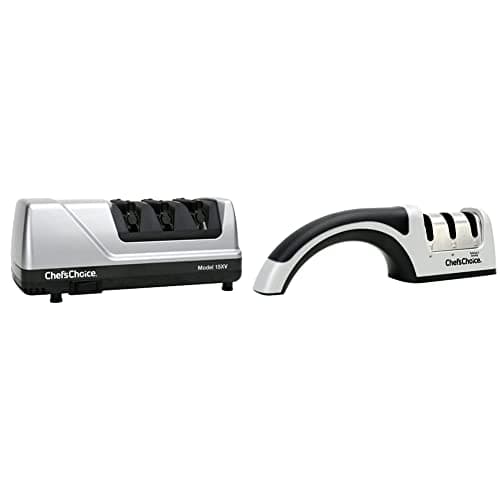
Chef'sChoice Trizor XV, 3-stage electric 15-degree sharpener
 See price on AmazonAmazon
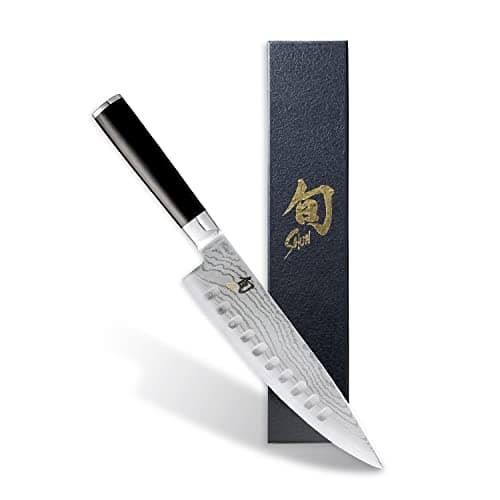
Shun Classic 8 in hollow ground chef, 16-degree
From Best Shun knives: Classic, Premier, Dual Core, Sora and Kanso
 See price on AmazonAmazon
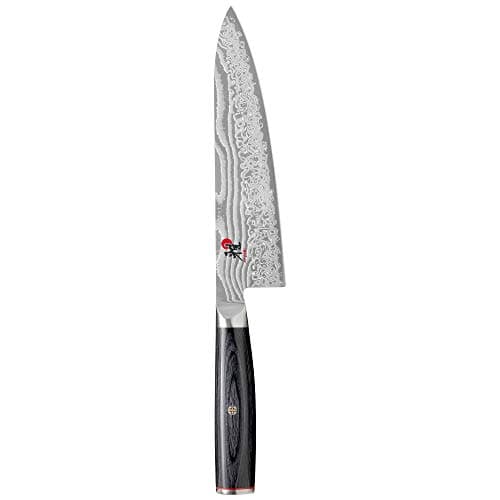
Miyabi Kaizen II 8" chef's knife, FC61 at 61 HRC
From Best Miyabi knives: Kaizen II, Mizu, Koh, Koya, Artisan, Birchwood and Black