Explainer
How many kitchen knives do you really need
Published
Short answer
Most home cooks need three knives: a chef knife or gyuto for most cutting, a paring or petty knife for small and in-hand work, and a serrated bread knife for crusty bread and tomatoes. Add a slicer, a nakiri or a set of steak knives only if you cook in a way that calls for them. A block set makes sense when it is priced close to the cost of the pieces you will actually use.
Picks for this job
All 8 picks compared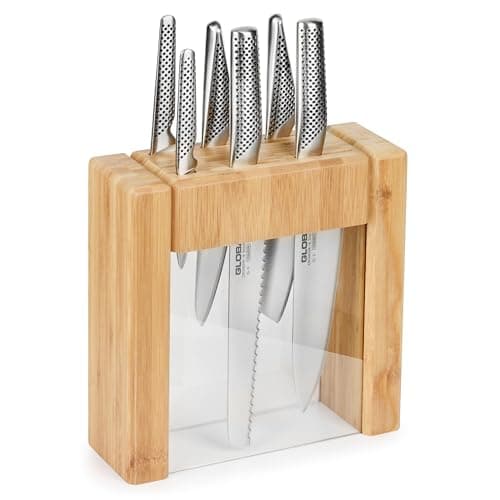
Global Ikasu 7-piece block set with nakiri
See price on AmazonSee it on Amazon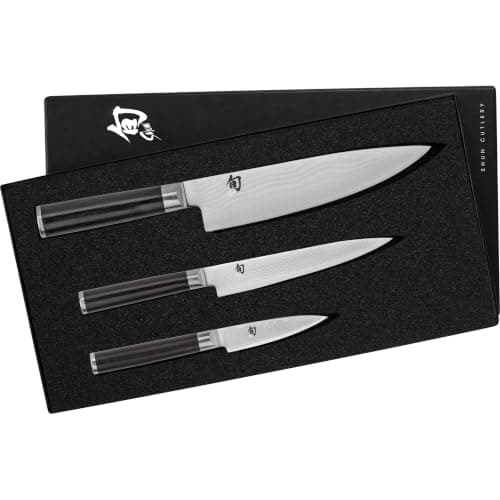
Shun Classic 3-piece: 8 in chef, utility, paring
See price on AmazonSee it on Amazon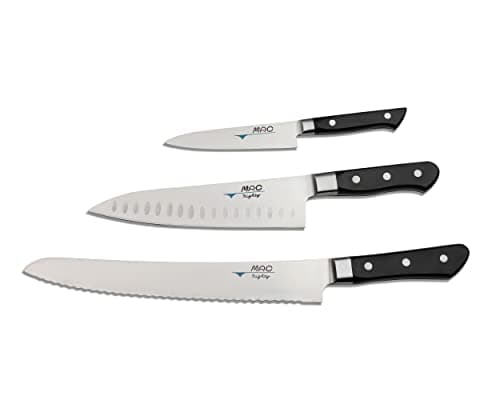
MAC Pro PRO-31: MTH-80 chef, paring, bread
See price on AmazonSee it on Amazon
This page is for anyone setting up a kitchen or replacing a drawer of dull, mismatched knives and wondering whether to buy a big block set or a few good individual knives. It lays out the three-knife core, the useful fourth and fifth knives, what professional cooks actually rely on, and a simple way to decide whether a set is worth it. Japanese and German options are both covered.
The three-knife core
Three knives cover nearly every job in a home kitchen. Buying these three well usually gives better results than buying ten knives of middling quality, because you will use the chef knife for most of your prep anyway.
牛刀Gyuto
180 to 270 mm
三徳Santoku
165 to 180 mm
菜切Nakiri
160 to 180 mm
文化Bunka
165 to 180 mm
切付Kiritsuke
210 to 270 mm
筋引Sujihiki
240 to 300 mm
ペティPetty
120 to 150 mm
Chef knife or gyuto
- Typical size
- 8 in / 210 mm
- What it does
- Slicing, dicing, mincing, boneless meat and fish
Paring or petty knife
- Typical size
- 3.5-6 in / 90-150 mm
- What it does
- Peeling, trimming, small fruit, in-hand cuts
Bread knife (serrated)
- Typical size
- 8-10 in
- What it does
- Crusty bread, tomatoes, cakes, citrus
| Knife | Typical size | What it does |
|---|---|---|
| Chef knife or gyuto | 8 in / 210 mm | Slicing, dicing, mincing, boneless meat and fish |
| Paring or petty knife | 3.5-6 in / 90-150 mm | Peeling, trimming, small fruit, in-hand cuts |
| Bread knife (serrated) | 8-10 in | Crusty bread, tomatoes, cakes, citrus |
Why the chef knife matters most
The chef knife does most of the work in a typical home kitchen, so this is where to spend the most. A Japanese gyuto is lighter and holds a keen edge longer; a German chef knife is heavier and more forgiving of rough use. Either is a fine choice, as explained in Japanese vs German knives. If you prefer a shorter blade, a santoku or bunka can fill this slot.
Size matters more than most people think. An 8 inch or 210 mm blade suits most cooks and boards. Our page on what size chef knife you need explains when a longer or shorter blade makes sense, and what a gyuto is used for covers the Japanese version in detail.
Useful fourth and fifth knives
Once the core is in place, add knives only for jobs you do often. Each of these does one thing better than a chef knife, but none is essential for everyday cooking.
- Nakiri: a flat, square vegetable knife for cooks who prep a lot of produce. See what a nakiri is used for.
- Sujihiki or carving knife: long and narrow for roasts, brisket, ham and raw fish. See the sujihiki guide.
- Boning knife: for breaking down whole chickens or trimming ribs. Japanese honesuki and Western boning knives both work.
- Steak knives: useful at the table, and a frequent reason people buy a block set.
- Kitchen shears: not a knife, but they save your good blades from packaging, string and poultry backbones.
- A cheap utility knife or cleaver for rough jobs like frozen food and hard squash, so your thin Japanese edge never has to do them.
Knife set vs buying individual knives
Block sets look like good value because the per-knife price is low, but many include pieces that rarely leave the block: several similar utility knives, a honing steel you may not use on hard Japanese steel, and a large number of steak knives. Count only the knives you would buy anyway, price them individually, and compare that number with the set price. If the set is close or cheaper, it is a good buy, and the block gives you safe storage.
Buying pieces makes more sense when you want to mix brands (a Japanese gyuto with a German bread knife is common), when you already own some decent knives, or when you prefer a magnetic strip or in-drawer storage. It also lets you put more of the budget into the chef knife.
Starting from nothing, want matching storage
- Better choice
- Block set with a good chef knife
Want a Japanese chef knife and a cheap bread knife
- Better choice
- Individual knives
Need steak knives too
- Better choice
- Set that includes them, if priced well
Limited counter space
- Better choice
- Individual knives on a magnetic strip
Gift for a new home
- Better choice
- Compact 3 to 7 piece set
| Situation | Better choice |
|---|---|
| Starting from nothing, want matching storage | Block set with a good chef knife |
| Want a Japanese chef knife and a cheap bread knife | Individual knives |
| Need steak knives too | Set that includes them, if priced well |
| Limited counter space | Individual knives on a magnetic strip |
| Gift for a new home | Compact 3 to 7 piece set |
What professional cooks use
Restaurant cooks often get by with surprisingly few knives. A typical line cook relies on a chef knife or gyuto, a petty or paring knife and a serrated knife, with a slicer or boning knife added for specific stations. Sushi and Japanese kitchens add single-bevel specialty knives such as the yanagiba and deba, which most home cooks do not need.
The lesson for home cooks is that the number of knives matters less than keeping one or two of them sharp. A sharpened 210 mm gyuto does more for your cooking than a 15-piece block of dull blades.
Keeping a small set in good shape
A small set is easier to maintain. Use a wood or soft synthetic cutting board, hand wash and dry each knife, and store blades so the edges do not touch other tools. Plan to sharpen the chef knife a few times a year for typical home use, more if you cook daily.
If you choose a block set, look for one with slots sized for the knives you will add later, or plan for a separate in-drawer block. Our page on how to store Japanese knives compares blocks, strips and sayas.
Frequently asked questions
Is one knife enough? For many cooks, a single good chef knife handles almost everything. Add a paring knife and a bread knife when you can, because those jobs are awkward with a long blade.
Are block sets a waste of money? Not always. A set is good value when the knives you would use cost about as much bought separately. It is poor value when you are paying mostly for pieces that stay in the block. See the block set guide.
Do I need a Japanese bread knife? No. Serrated knives are hard to sharpen at home and benefit little from harder steel, so a moderately priced bread knife is fine.
Should all my knives be the same brand? There is no need. Matching sets look tidy, but mixing a Japanese chef knife with Western utility knives is common and practical.
What you need for this
- See price on AmazonAmazon
Global Ikasu 7-piece set, Cromova 18 at 58 HRC
From Best Japanese knife sets built around a gyuto or santoku
 See price on AmazonAmazon
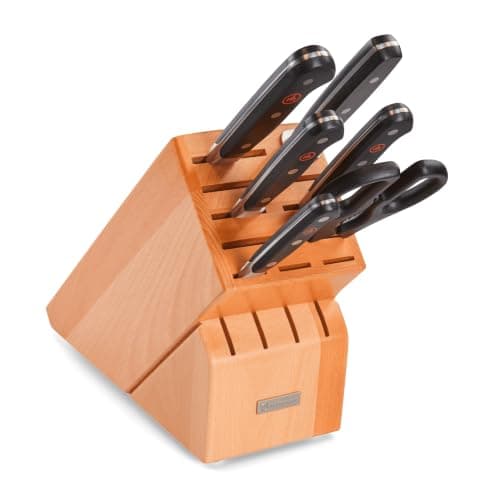
Wusthof Classic 7-piece block set, 58 HRC
 See price on AmazonAmazon
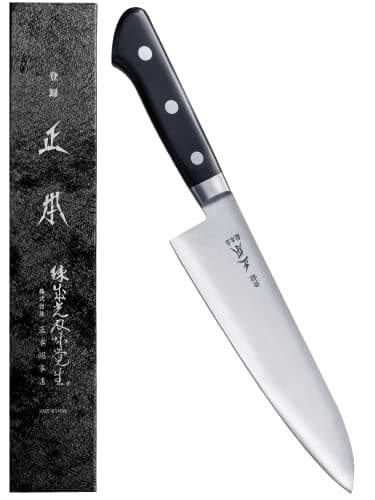
Masamoto VG 240 mm gyuto, HRC 58-59, POM handle
From Best gyuto knives: Japanese chef knives in 210 and 240 mm
 See price on AmazonAmazon
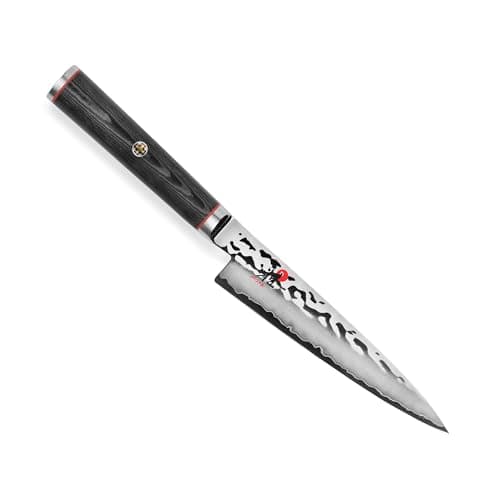
Miyabi Mizu SG2 5" utility at 63 HRC