Explainer
Aogami (blue) and Shirogami (white) steel explained
Published
Short answer
Shirogami (white paper steel) is a very pure high-carbon steel that sharpens quickly to a keen edge. Aogami (blue paper steel) is the same base with chromium and tungsten added, so it holds an edge somewhat longer and is a bit harder to sharpen. Aogami Super adds more alloying for even longer edge retention. All of them rust and need to be kept dry.
Picks for this job
All 7 picks compared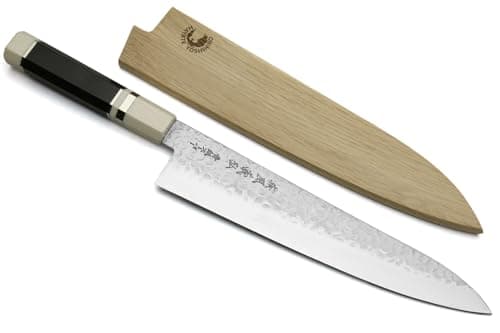
Yoshihiro Super Blue 210 mm gyuto, 63-64 HRC
See price on AmazonSee it on Amazon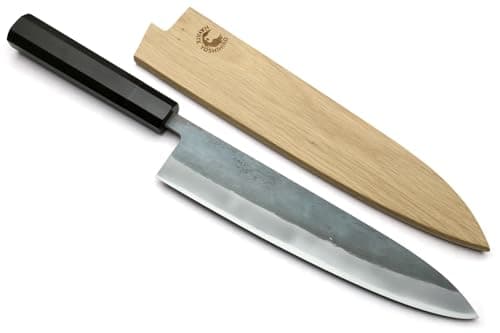
Yoshihiro Kurouchi Blue #2 240 mm gyuto with saya
See price on AmazonSee it on Amazon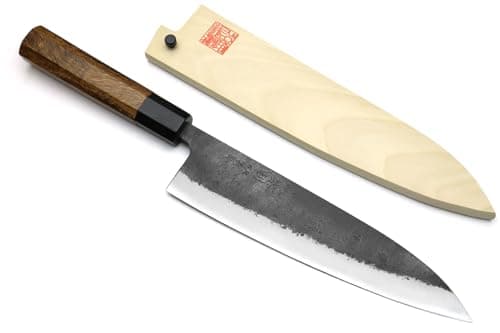
Yoshihiro White #2 Nashiji 210 mm gyuto, cocobolo
See price on AmazonSee it on Amazon
If you shop for carbon steel gyuto or nakiri knives, you will see Aogami 1, Aogami 2, Aogami Super, Shirogami 1 and Shirogami 2 in listings. These names refer to carbon steels traditionally made by Hitachi Metals (now Proterial) in Yasugi, Japan, and named after the color of the paper they were wrapped in. This page explains the grades in plain terms, typical hardness, how each sharpens, and the care every carbon steel needs.
What paper steels are
Aogami (blue) and Shirogami (white) are part of the Yasugi Specialty Steel family, often called paper steels because the bars were labeled with colored paper. Both are high-carbon steels with very low levels of impurities such as phosphorus and sulfur, which helps them take a fine, keen edge.
They are not stainless. Without enough chromium to resist rust, they will discolor and rust if left wet. For that reason most modern knives in these steels are clad: a hard carbon core is sandwiched between softer iron or stainless steel layers, which protects most of the blade and makes it easier to sharpen and less brittle. The edge itself is still carbon steel.
Shirogami (white steel) grades
Shirogami is close to plain iron and carbon. Shirogami 1 has more carbon than Shirogami 2, so it can be hardened a little higher and holds an edge slightly longer, but it is also a little more brittle. Shirogami 2 is the more common and forgiving grade. Shirogami 3 has less carbon and appears in lower-priced knives.
White steel is known for sharpening very quickly on whetstones and taking an extremely keen edge. Its edge retention is shorter than blue steel. Traditional sushi chefs often favor it for yanagiba and other single-bevel knives because it is easy to bring back to razor sharpness.
Aogami (blue steel) grades and Aogami Super
Aogami starts from a white steel base and adds chromium and tungsten. These help the steel hold an edge longer and add some toughness. Aogami 1 has more carbon than Aogami 2; Aogami 2 is the most common grade in knives and is often described as a well-balanced choice.
Aogami Super has more carbon plus added molybdenum and vanadium. It is usually hardened higher and is known for long edge retention among carbon steels. It is slower to sharpen and can be less forgiving of twisting or hard foods.
- Edge retention
- rises with hardness
- Chip risk
- rises with hardness
- Ease of sharpening
- falls with hardness
Steels on the chart: X50CrMoV15 HRC 56 to 58; Cromova 18 HRC 56 to 58; AUS-10 HRC 59 to 60; VG-10 HRC 60 to 61; VG-MAX HRC 60 to 61; FC61 HRC 61 to 61; Ginsan (Silver 3) HRC 60 to 61; SG2 / R2 HRC 62 to 64; ZDP-189 HRC 64 to 66; Shirogami 1 and 2 HRC 61 to 64; Aogami 1 and 2 HRC 61 to 64; Aogami Super HRC 63 to 65.
Hardness and behavior compared
Hardness depends on each maker's heat treatment, so ranges are typical rather than exact. The steel chart uses the same widely cited ranges.
Shirogami 2
- Typical HRC
- 61 to 64
- Edge retention
- Good
- Ease of sharpening
- Very easy
- Rust
- Rusts, needs drying
Shirogami 1
- Typical HRC
- 61 to 64
- Edge retention
- Good, slightly longer
- Ease of sharpening
- Very easy
- Rust
- Rusts, needs drying
Aogami 2
- Typical HRC
- 61 to 64
- Edge retention
- Longer than white
- Ease of sharpening
- Easy
- Rust
- Rusts, needs drying
Aogami 1
- Typical HRC
- 61 to 64
- Edge retention
- Longer than Aogami 2
- Ease of sharpening
- Easy to moderate
- Rust
- Rusts, needs drying
Aogami Super
- Typical HRC
- 63 to 65
- Edge retention
- Longest of the group
- Ease of sharpening
- Moderate
- Rust
- Rusts, needs drying
| Steel | Typical HRC | Edge retention | Ease of sharpening | Rust |
|---|---|---|---|---|
| Shirogami 2 | 61 to 64 | Good | Very easy | Rusts, needs drying |
| Shirogami 1 | 61 to 64 | Good, slightly longer | Very easy | Rusts, needs drying |
| Aogami 2 | 61 to 64 | Longer than white | Easy | Rusts, needs drying |
| Aogami 1 | 61 to 64 | Longer than Aogami 2 | Easy to moderate | Rusts, needs drying |
| Aogami Super | 63 to 65 | Longest of the group | Moderate | Rusts, needs drying |
Note.Blue steel is often said to rust a bit less readily than white steel because of its added chromium, but neither is stainless. Treat both as reactive carbon steels.
How they compare with stainless steels
Against stainless VG-10 (about HRC 60 to 61), paper steels usually take a keener edge and are easier to sharpen, but they need more care. Against SG2 powder stainless (about HRC 62 to 64), Aogami Super offers similar hardness with a different feel on the stone and no rust resistance.
If you want low maintenance, a stainless knife is the safer choice. If you enjoy sharpening and do not mind wiping the blade dry while you cook, carbon steel rewards you. See carbon vs stainless Japanese knives and VG-10 vs SG2.
Listings: what Aogami and Shirogami knives cost
Current Amazon listings include Yoshihiro Kurouchi blue steel gyuto, nakiri, sujihiki and petty knives from about $210 to $470, Yoshihiro Hammered Super Blue steel gyuto from about $260 to $300, and Yoshihiro white steel #2 Nashiji gyuto and nakiri from about $260 to $290. Most of these are stainless-clad, which limits rust to the exposed edge.
A kurouchi finish leaves the dark forge scale on the upper blade. A nashiji finish has a textured, pear-skin look. Both are cosmetic choices that also hide scratches. See how much Japanese knives cost for price tiers.
Care for blue and white steel
Every paper steel needs the same basic routine. It takes only a few seconds per use once it becomes habit.
- 1
Wipe the blade dry during prep, especially after acidic foods like tomatoes, citrus and onions.
- 2
Wash by hand with mild soap, rinse and dry fully right away.
- 3
For storage, apply a thin film of camellia or mineral oil. See Japanese knife oil.
- 4
Let a patina develop; it helps reduce reactivity. See carbon steel knife patina.
- 5
Remove any orange spots early with a fine abrasive. See Japanese knife rust.
Frequently asked questions
Is Aogami better than Shirogami? Neither is better overall. Aogami holds an edge longer; Shirogami sharpens faster and takes a very keen edge. Pick based on how often you want to sharpen.
What does Aogami 2 mean on a gyuto? It means the cutting core is Blue Paper Steel grade 2, a common, well-balanced carbon steel. Most Aogami 2 gyuto are clad in softer iron or stainless steel.
Is Aogami Super stainless? No. Aogami Super is a carbon steel and will rust if left wet. Stainless cladding protects the sides of many knives, but the edge still needs care.
Are paper steels good for beginners? They are fine if you will dry the knife promptly. Beginners who want low maintenance usually do better with stainless steel.
What you need for this
- See price on AmazonAmazon
Yoshihiro Super Blue 210 mm gyuto, 63-64 HRC
 See price on AmazonAmazon
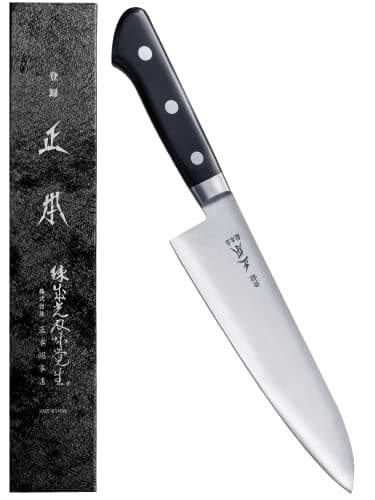
Masamoto VG 240 mm gyuto, HRC 58-59, POM handle
From Best gyuto knives: Japanese chef knives in 210 and 240 mm
 See price on AmazonAmazon
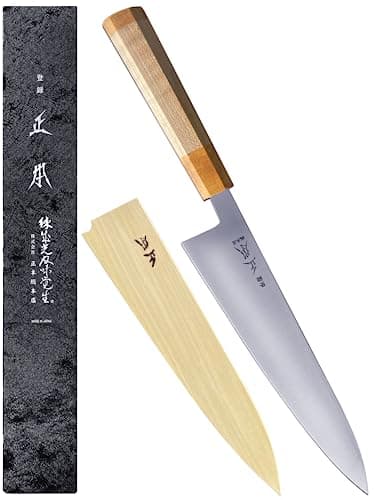
Masamoto KS 240 mm gyuto, Shirogami #2 at HRC 62-63